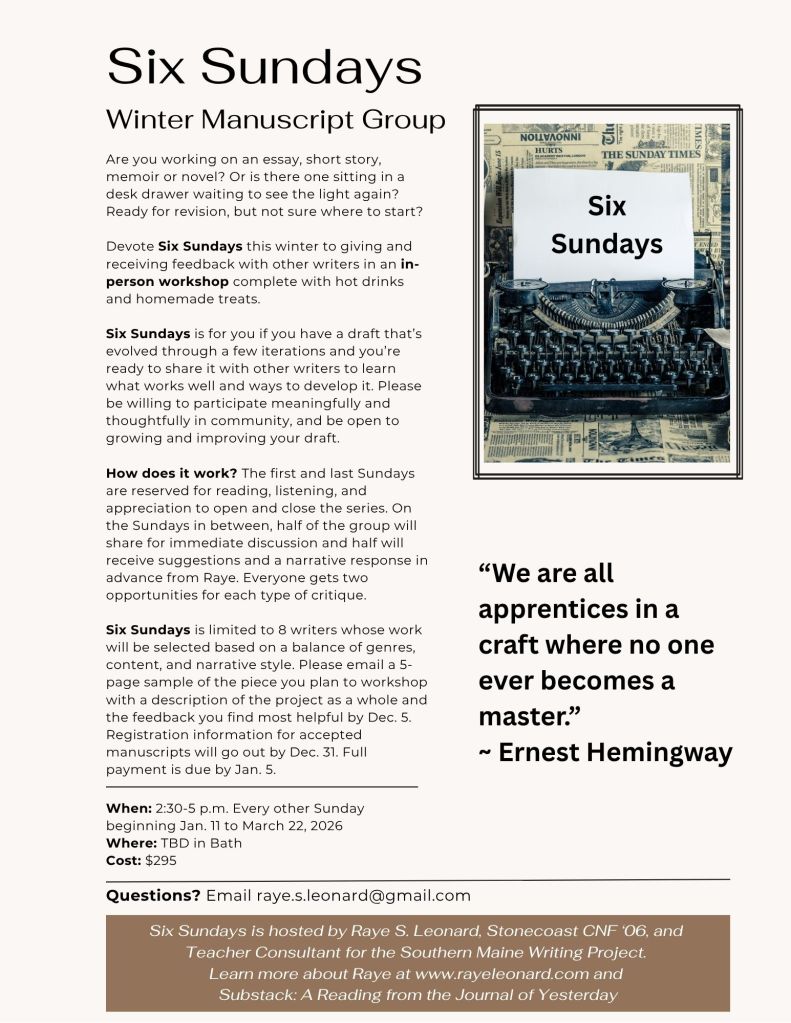
Six Sundays Winter Manuscript Group
If you have not already done so, please check out my Substack, A Reading from the Journal of Yesterday, where I write about reading my old journals, and what to do with all these volumes of personal writing. I share with all subscribers, but my recent ramble about writing as a trauma response was pretty vulnerable. As I get deeper into this reflective practice, I will limit some posts to paid subscribers only. Just $5 a month or $55 for a whole year.
Do you have old journals, too? Don’t burn them! Learn how to harvest wisdom from your very own words by opening these love letters sent by who you used to be. I will guide you in thoughtful engagement with your primary source material through reflective writing exercises, curiosity prompts, and suggestions for developing personal writing into narrative forms. The group will create a supportive space for integrating the seasons of life experience into the present moment. Sign up by emailing raye.s.leonard@gmail.com. Preferred payment by Venmo @Raye-Leonard-1, but we can make other arrangements.
I launched a Substack in March called A Reading from the Journal of Yesterday where I am happily posting reflections somewhat regularly from my lifetime collection of journals and personal writing. I am cross-posting my most recent entry here because I would love for readers of this blog to join me there.
As a thank you to long-time followers (and believers in) my work, at the end of this post, I include an excerpt from a chapter of my memoir-in-progress that you can read without becoming a paid Substack subscriber.
I changed my name to Shelly on my Facebook profile two months ago in celebration of my 35th high school reunion. It’s the name I grew up with.
I didn’t realize it would be 60 days, according to META rules, before I could change it back to Raye, the name I’ve used for over 30 years.
I’ve told the story of how I went from Shelly to Raye many times since the first of June. No, I am not now and never was in a witness protection program. I was not trying to reinvent myself in my early 20s, though I appreciated the fresh start of going to college like anyone else.
I am not trying to be someone I’m not. I simply become more and more who I am.
Some people say, “You’ll always be ‘Shelly’ to me.” It’s spoken like a secret, as if the person knows something about me that others may not simply because they “knew me when.”
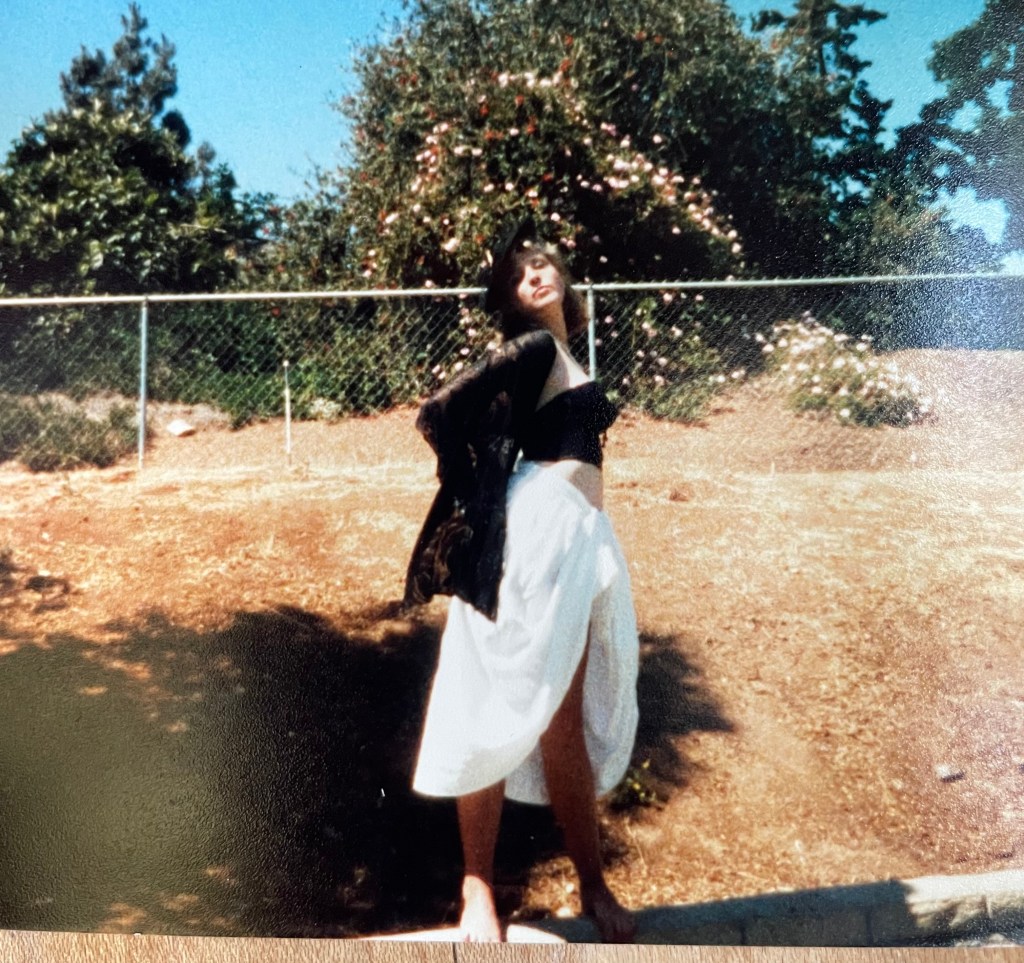
When was that exactly? Who was that me?
Only a very special few have known me through all my names, speaking to me in every language of myself.
In celebration of switching back to Raye on Facebook today, here’s an excerpt from a chapter of my memoir-in-progress that explains what’s in my name.
Click to download chapter excerpt.
I will continue to update this website from time to time, so I hope you will stick around. Please also join me on Substack where I share generously from my work, even for free subscribers. If you want to become a paid subscriber, it’s just $5 a month or $55 a year, and includes content just for you, commenting options, prompts to support your own personal writing excavation, and discounts on workshops.
Thank you for following me wherever you find my work!
Me and Jesus, to quote the oft-covered song by Tom T. Hall, got our own thing going.
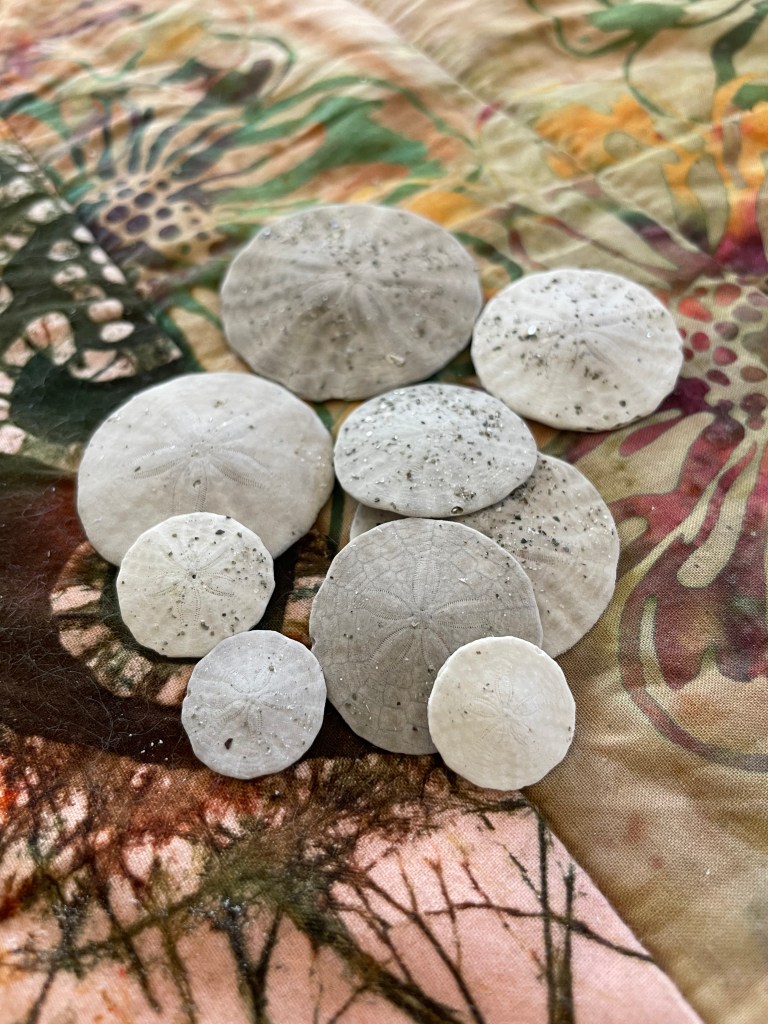
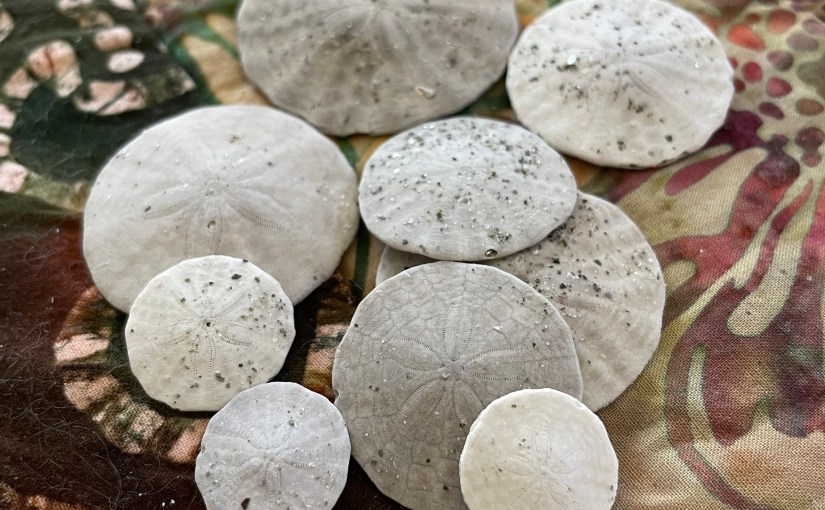
I spent the last 40 days – Lent, in the Christian tradition – on a journey back to what I’ve always known. I don’t need no fancy preaching. The shore marked with my own footprints, a pulpit made of stones, the hymn of the sea, and a handful of sand dollars.
That’s church enough for me.

I tried, like I did at Advent, to have a Catholic experience of Lent. There’s a rough rock tumbling around in my memoir project that has to do with being Catholic. I want to smooth it with understanding what it might have meant for my mother and grandfather to be Catholic. How did that religious persuasion shape their beliefs, inform their choices?
My personal Catholic experience was derivative, lightened to the point of a complete fade compared to the rigid French-Canadian Catholicism of my grandfather’s generation, and to a large extent my mother’s.
What I’ve been trying to get at in my Catholic journey is a sense of what it was like for them to be Catholic. My empathy game is so strong I probably feel it before you do, so it was no wild imaginative leap to believe I’d glean something of what they may have felt going through the liturgical year myself.
But my own feelings were the only thing I felt.
And what I felt most persistently was why am I here? I loved the ritual of Mass, and St. John’s full of so many souls on a Sunday made me want to kneel with them in the joy of simple belonging.
But I needed the laminated cheat sheet to make it through all the prayers. I never had enough cash for the second collection. And ultimately – unwittingly – I committed a mortal sin.
About mid-Lent, I bumped into an old friend from my Coastal Journal days after Mass. She pointed out I ought not to be taking Communion because I was not in a state of grace. It was a mortal sin to do such a thing. And if she didn’t say something to me about it, that would be her own mortal sin.
Like everything except the most basic Catechism, I am not entirely sure what it means to be in a state of grace, or why not being so puts a soul in such peril. But mortal sin sounded like I was marked for a smiting by God himself. That didn’t sound good.
Even though I am pretty sure I offend God at least five different ways daily – probably more – I don’t need to add mortal sin to the ledger of worries already in the queue of my midlife maladies.
I never went back to Mass after that. Half my Lenten journey was about as far from a Catholic one as you can get.
That doesn’t mean it wasn’t holy. Me and Jesus, as I said, got our own thing going.
I knew there were rules about the Communion wafer. But I thought I just needed to confess my sins before I stuck it in my mouth. I figured I do that every single morning when I ruminate in my journal. And anyway, when I went to a UCC church, everyone got some bread to dip in the grape juice. Was it really so awful as to be a mortal sin?
He’d forgive me. Jesus, I mean. About Communion. That’s what I think.
I could hear him saying, “Look it’s not really like that. I don’t need you to do anything besides show up and actually care. If it were up to me, there wouldn’t be all this [waves arm in a dramatic scriptural gesture]. But if you want to be a Catholic, well, then you gotta do it their way.”
I hit the highway instead.
Or should I say the beach?
In my muck boots, I plodded along the low-tide Popham wrack line this Easter morning, sifting shells from seaweed with my eyes.
“What are you looking for?” A woman asked.
“Sand dollars,” I said, looking up.
She walked toward me with her hands cupped. “Here,” she said.
I opened a palm, and she tipped a handful of sand dollars into it.
“Are you sure?” I said, astonished. I’ve found a bazillion sand dollars since 2020. I still have every single one. They are the bread crumbs that led me on my own clumsy walk of faith. Each is an answered prayer, an idea born, a fear abandoned.
“I have more than enough,” she assured me, squeezing my other hand with her now free one. She continued down the beach.
Now that’s my kind of Communion.
“Peace be with you,” I called, and she turned back to wave.
Together and to each other we shouted, “Happy Easter!”
Revised on April 4, 2024.
(It’s not quite ready yet, but if you’d like to read more about “me and Jesus,” please subscribe to A Reading from the Journal of Yesterday, my coming-very-soon Substack. Originally, I thought this project would literally be posts of personal writing from 42 years of my journals – and my present-day reflections on getting to know the “people I used to be.” But I expanded it to include anything from my extensive unpublished archives, including the Jesus Shorts I wrote and shared with a few pastor friends in 2010. I’m having way more fun revisiting creative work, but culling through it takes more time than simply pulling 1984 from the shelf and wincing through pages of early adolescent breakups. A Reading from the Journal of Yesterday is free – but thanks in advance if you would like to pay a little bit for it. That’ll help keep me in motel fees while I finish my memoir. Either way, I hope you will subscribe!)
After attending an accordion pocket book class at Lulu’s Barn with book binder Joelle Webber of Mermaid Bindery, I was inspired to adapt the project to make an Advent calendar for everyone in my weekly writers’ group, plus two poets in my monthly book group.
I came up with a writing prompt for each day, printed them, and cut them into little slips I tucked into each slot, along with handcrafted tea by my friend Kate’s Merry Auld Tea Company.
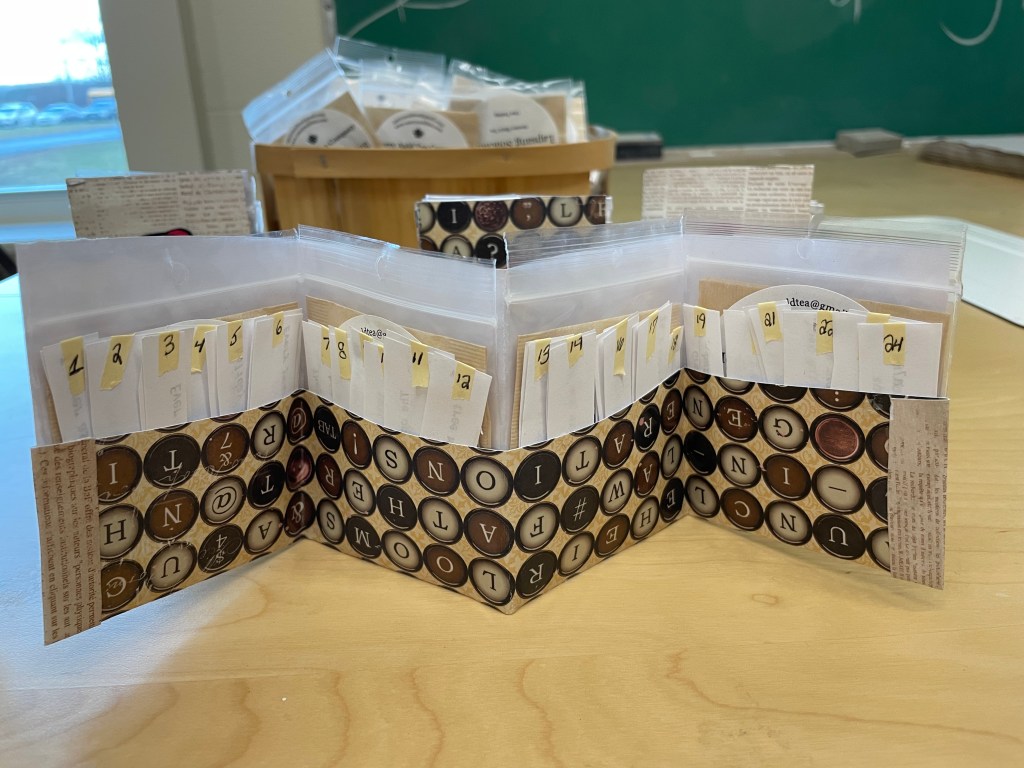
I got them in the mail just in time so everyone received them by Dec. 1. I told myself this would be my only Big Make of the holiday season because, as I’ve mentioned, I set out to be properly sad for a change.
(I had so much fun coming up with prompts and making these little books that I plan to do it again. If you would like to be on the list to receive one in time for Advent 2024, please email me and I will be in touch when I work out the design. I will likely charge a small fee to cover the cost of supplies and shipping, just to be totally transparent.)
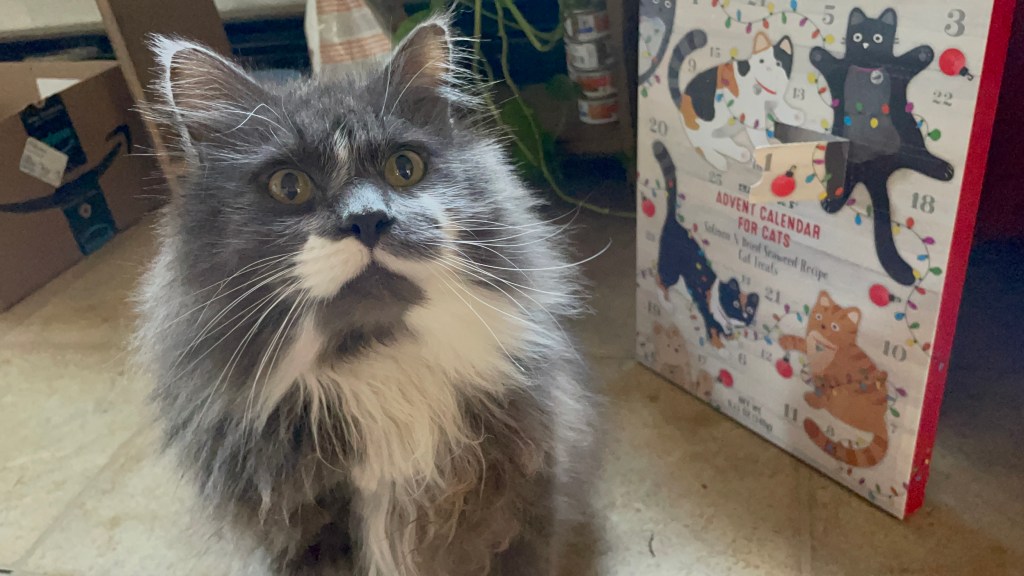
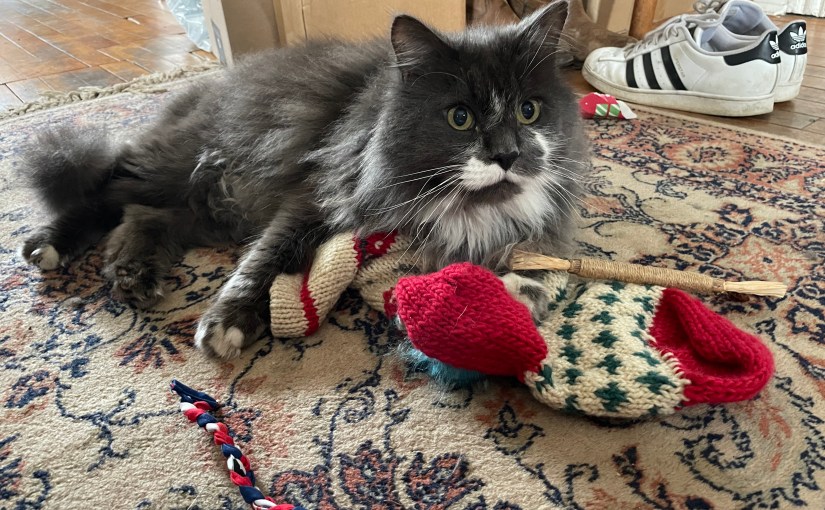
I handed out Trader Joe’s Advent calendars to my family at Thanksgiving. Even the cat got his own box of daily delights.
Each day, I opened my own Advent calendar. It was filled with promises for future together times, reminders that I am loved, chocolate, and baubles given by my husband, a dear friend, and my oldest son. My middle son who was away at school added a song to special Spotify playlist for me every day, and my youngest surprised me with occasional Italian pastries and bougie chocolate. They even cleaned their room!
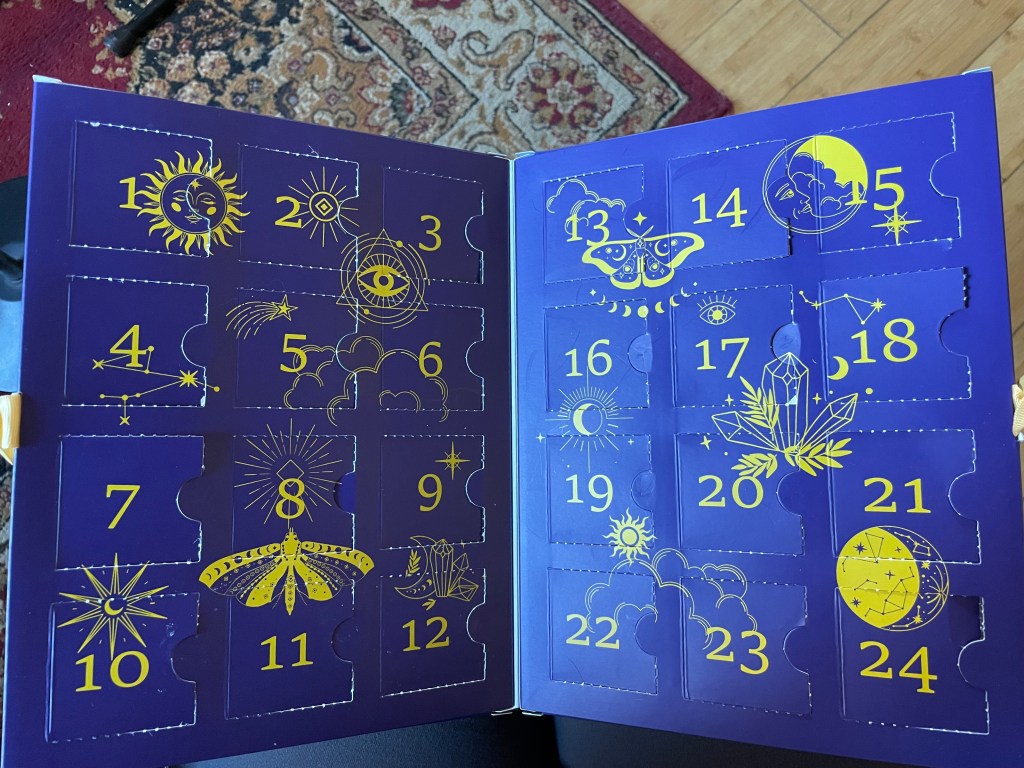
It was no small thing for me to ask for my family’s help celebrating Advent in this way, but it was worth feeling a little vulnerable so I wouldn’t know what was behind each door. That they happily obliged was a tremendous gift in and of itself.
This Advent and Christmas season also brought me unexpected gifts every day, or as the little Advent book refers to it, “evidence of God’s grace.”
I set out to grieve during the holiday season instead of ignore it’s dull ache by endlessly doing. All these years, I thought I was avoiding the emptiness Christmas brings because my mother isn’t here to make it special the way only a mother can. But I’d probably have been sad even if she was still alive. I have an endless capacity for bleak thinking.
In my unwrapping of all I box up and keep out of sight, my own expectations and disappointments probably hurt me more than anything else.
Maybe that’s why the unexpected gifts meant so much (and will forevermore).
I won’t itemize all of them, but a few stand out.
There were no farm animals at Our Lady Queen of Peace’s Live Nativity in Boothbay Harbor on Dec. 2.
Where were the lowing cattle? The sheep? And goats?
But, of course, live Nativity meant real people dressed as Mary and Joseph, King Herod, the wisemen, all clustered around a manger with an actual baby in it.
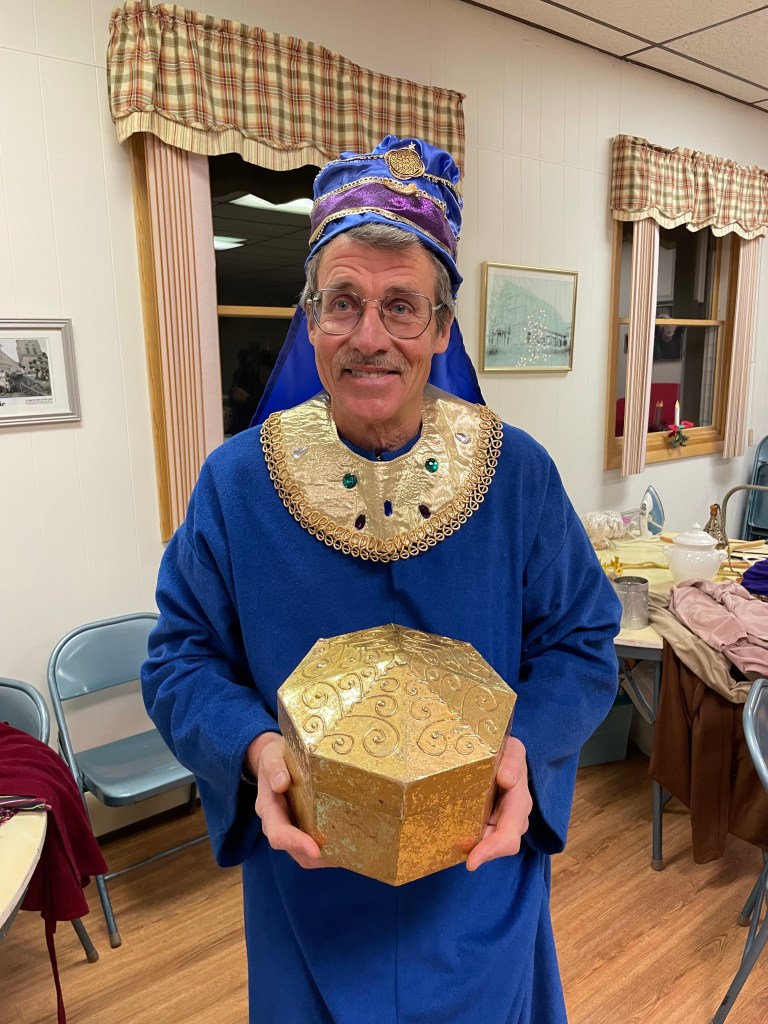
I already mentioned I’m a sketchy Catholic, but I felt utterly daft for expecting some kind of holy petting zoo. I laughed out loud at the absurdity of my mistake.
An unexpected gift. Usually, I crumple with embarrassment when I get something so completely wrong.
Another bit of grace came from a woman who tried to help me help my college freshman who was overcome by chronic tonsilitis and a terrible cold at the end of the semester.
She said, “What would we do without Mummas,” as she scribbled a name and number on the back of a business card and sent us off with hope of salvaging some grades.
Indeed.
I don’t often feel very effective with my well-intentioned but fumbling support of my third kid in the ways they need most, so I appreciated the nod that perhaps I was getting it right. In that moment anyway.
A couple of school cancellations arrived as miracles that made it possible for me to finish the final assignment of Organizational Behavior, a graduate class I took as part of the Certificate of Advanced Study in Adult Learning I am working on.
I also sent my adult ed brochures to the printer on time, thanks to the focus working from home on them allowed. The office is often the last place for getting anything, especially like this, done during the busy lead up to holiday break.

Thanks to limiting overdoing I was present enough to notice these surprises in the moment.
Something else snuck into my awareness, too.
I tell myself a story that I fell from grace when my first marriage ended. That’s no big deal really. I just made it more awful by blogging about it because at the time I was a successful pro blogger and that’s what bloggers did. This post originally veered way off course – and into dangerous emotional territory for me – detailing that tailspin 13 years ago. None of which needed to be said.
The short of it is that I’ve lived with a lot of shame over the last decade. Shame is even more painful than sorrow.
“Shame,” Brene’ Brown writes in Dare to Lead, (my book choice for Organizational Behavior) “is … the fear that something we’ve done or failed to do, an ideal that we’ve not lived up to, or a goal that we’ve not accomplished makes us unworthy of connection… Shame is the intensely painful feeling or experience of believing that we are flawed and therefore unworthy of love, belonging, and connection.”
That’s been me for over a decade. I’ll completely unpack that box someday, too. But not right now.
I’m busy unwrapping my heart, the most amazing unexpected gift of all.
Thank you for reading along with my Advent and Christmas writing project. I’m about to launch a busy spring semester. It’s my intention to blog again before summer break, but we’ll see. Stay tuned and feel free to stay in touch!
Did you know it’s technically still Christmas? If you are Christian (maybe, specifically Catholic), you probably did. In fact, Christmas Day is just the beginning of Christmas. Those 12 days we sing about with the partridge in a pear tree? It’s a real thing.
I knew this and also didn’t know this because it wasn’t until this Christmas that I set out to experience it as something more than something to just get through. So when the small, free book I picked up at St. Mary’s called Daily Reflections for Advent & Christmas, by Susan H. Swetnam, didn’t end Dec. 25, I thought, oh that’s right. There’s more.
Advent – from the Latin adventus – is about waiting, anticipation, the arrival, the coming of Jesus.
But as every new parent knows, birth is just the beginning. It’s everything that comes after that’s the journey. After the baby showers (and these days, the gender reveal party), and the big bang of being born, you’re left to figure out how to live with what you brought into the world.
Or, in the case of the consumer-focused holiday we celebrate on Dec. 25, how to incorporate your new oven mitt, nautical chart, Duke Cannon Man soap supply, and flannel sheets into the flow of daily life, announcing not only the thoughtfulness of the item, but your appreciation of it.
Social media memes point out that the time between Christmas and New Year’s is a special somewhat unmoored time out of time when you’re not sure what day it is or even what hour. You might wear the same pajamas … forever.
Judging by the handful of hanging-out-at-home clothes I just put in the wash, I made it through this week with commendably few wardrobe changes. Our meal plan was leftovers. When we ate through those, we scavenged the stockings for hard candy. Girl dinner became dark chocolate sea salted caramel snowmen, a handful of German candied nuts, and the last of the charcuterie d’affinois (a buttery, melt-in-your-mouth, soft French cheese).
It is as it is (sort of) supposed to be.
Maybe we don’t celebrate the feast of St. Stephen (Dec. 26, or as some call it, Boxing Day), or the Day of Holy Innocents (Dec. 28), or the Fifth Day within the Octave of the Nativity of the Lord (Dec. 29). I know all of this because of my little Advent book.
But this time is meant to be not like other time. Social media doesn’t always get it totally wrong.
The little Advent book says Dec. 27 is St. John the Apostle’s Day. But this day is significant to me for other reasons because my mom died on it. I may not have known all the saints and feast days until this year, but this day is as much an annual observance for me as any holiday. Just darker. Much much darker.
I set out to have a specific experience this Advent season. I wanted to actually show up for the grief that comes with every Christmas like the nonsensical, stupid, not-funny joke gift that nobody should get stuck with at the Yankee Swap.
This year, I wanted to turn around and look this unwelcome Ghost of Christmas Past in the face as it sidled along beside my shopping cart that I filled with stuff meant to blot out it’s rude intrusion on what’s supposed to be the most wonderful time of the year.
Instead of waving this mean spirit away with a broomstick in my hand and sweeping the broken pieces of my heart into a corner with the red-and-white jimmie sprinkles and crushed candy canes, I wanted to kneel inside my sorrow and hold each shard in my hand.
I would not toss a holiday-checked tablecloth over the ghost (even as it played musical chairs with my memories). There would be no over-baking, over-decorating, over-giving (over-spending), over-eating … Anything I typically overdid (with all the bells on and tangled in bows), I would not overdo this year because it was so totally and completely overdone.
My grief, on the other hand, was overdue.
My kids were little when my mother died 18 years ago. My youngest was not even a year old. It’s easy to leave sadness packed away, an ornament too precious to hang, when the holiday decor is more about soft items little hands would not break. My grief was safely kept in a box padded and molded in the shape of my heart where it would not shatter …. I mean, actually, where it would not shatter me.
I dug it out of the attic shadows this year and brushed the dust off the lid.
My sorrow shines just like it did when I put it away, catches the light just right, sparkling like snow in headlights.
It’s kind of like Christmas, you know? It keeps it’s promise.
When you live in past, there is no hope.
It’s safe there. I mean, if you tell the same story over and over again, there are no surprises, right?
Little kids love this because when they are read to, they anticipate their favorite parts. Then when they pick up those books to look at by themselves, they turn the pages and say the story as if they are reading it. This is a vital stage in pre-literacy, something I know just a little bit more about after taking a graduate-level class earlier this year.
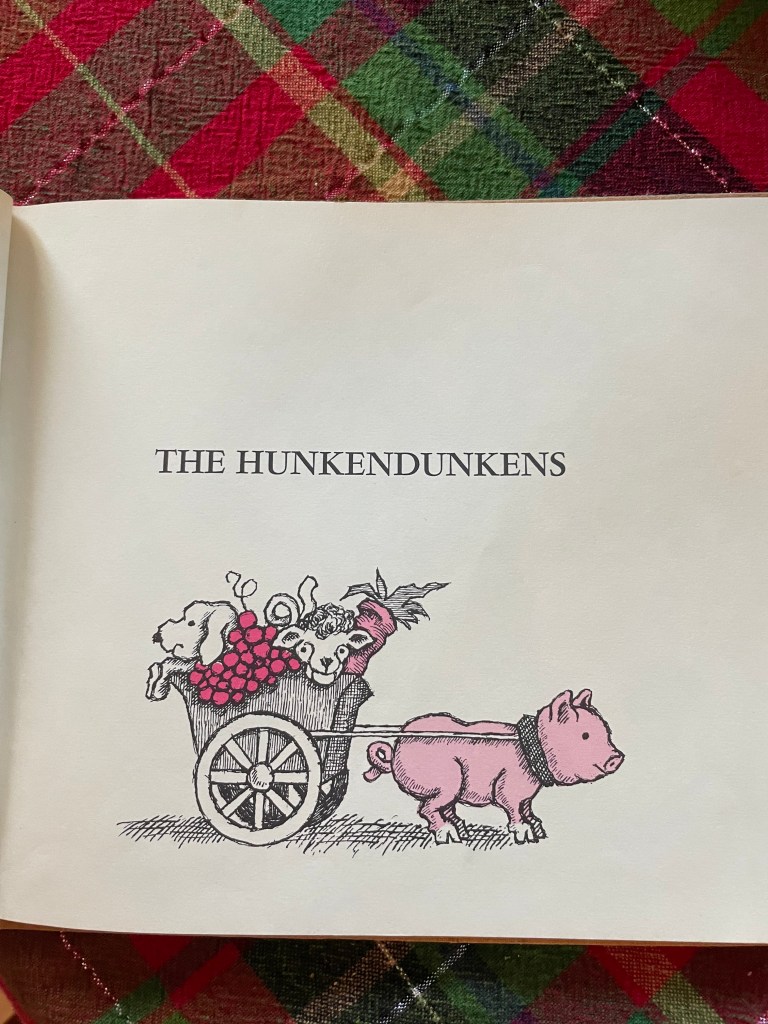
This literacy pre-ramble might have nothing to do with hope. But it has everything to do with stories.
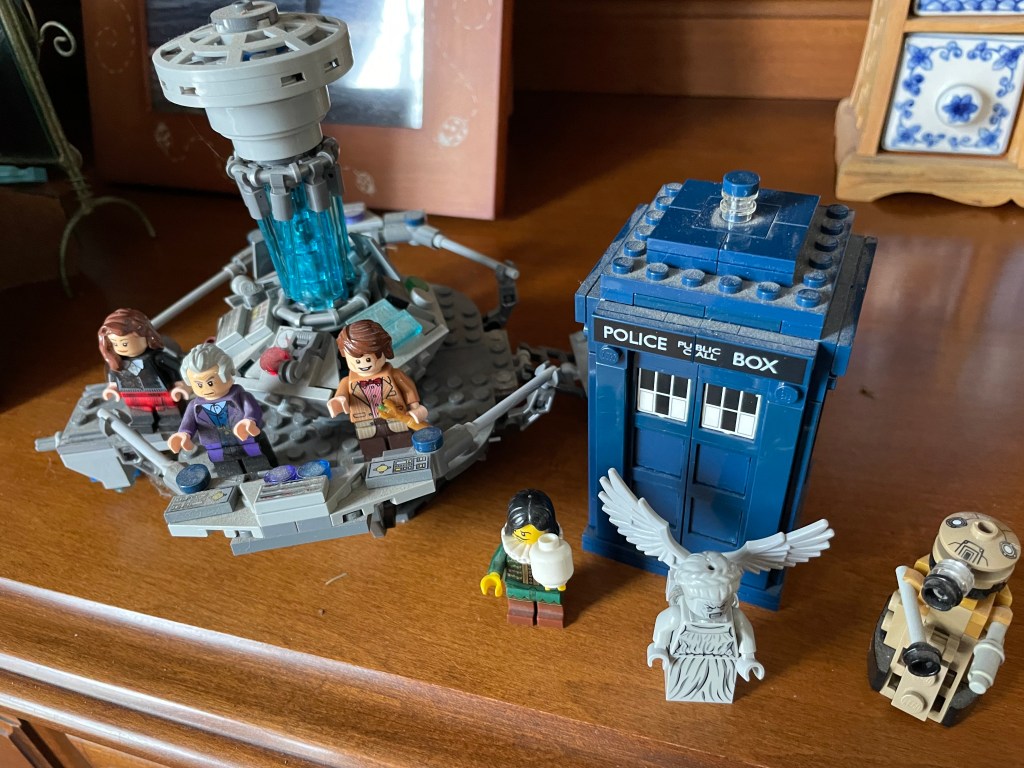
It’s one thing to read, watch, or (for my grown-up Zoomer kids) play a special story over and over again. For example, I always re-read The Snow Child, by Eowyn Ivey during my January hibernation because it’s a cold-weather tale and I love it. My family likes to re-watch the 10th Doctor Who (David Tennant/Russell T. Davies era) Christmas specials this time of year. The Zoomies still love Civilization, a video game they first played with their dad when they were small.
Stories like these live outside of us. They’re not the problem. It’s the ones that live inside that destroy hope.
At least, that’s what occurred to me yesterday morning as I dragged inside the house the hope chest from my youth that my father dropped off. It was previously in the storage unit he cleaned out over Thanksgiving.
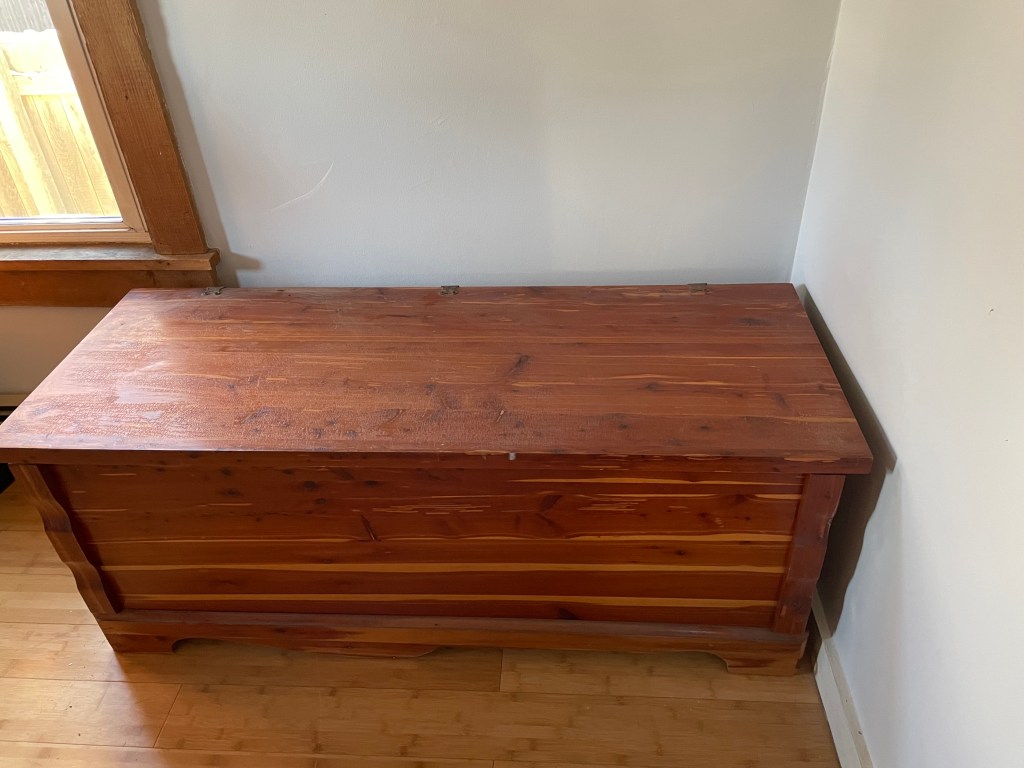
I emptied the hope chest’s contents into a plastic tote weeks ago and stashed it in the basement with all the other boxes of my past lives. I’ll go through it someday. Or actually probably I won’t. (But I should.)
It was hard enough to go through the last 20 years of my writing to put together a manuscript this summer. An old professor and dear friend encouraged me to do this so I could get on with publishing a book and becoming an author.
But it was spending two-and-a half months preparing for Maine Writers & Publishers Alliance’s Pitch event in September that pushed me into the archives of my written life to pull together something publishable from my old M.F.A. thesis, blogs I once kept, newspaper columns, and other material, some published but most not.
Pitch, I figured, was a great way to give myself a goal to produce a body of work. Being pressed up against a deadline works for me: The survival instinct kicks in and I write like hell to save myself from threats only a conspiracy of my imagination and inner critic could come up with.
This is a terrible way to work with the material of your life in writing, especially when so much of it was produced years – even decades -ago. As Joan Didion said, “I’ve already lost touch with a couple of people I used to be.”
Re-reading, revising, and reworking my personal narratives of record took living in the past to a whole new level.
It meant reliving it. And it was hard enough the first time.
My manuscript was not finished when I went to Pitch. I thought about bailing out because I was assured by countless writing professionals, across just about every stage of publishing, that I shouldn’t pitch until my work was as polished as it could possibly be. But I was also assured by some of the same people that my manuscript didn’t have to be perfect.
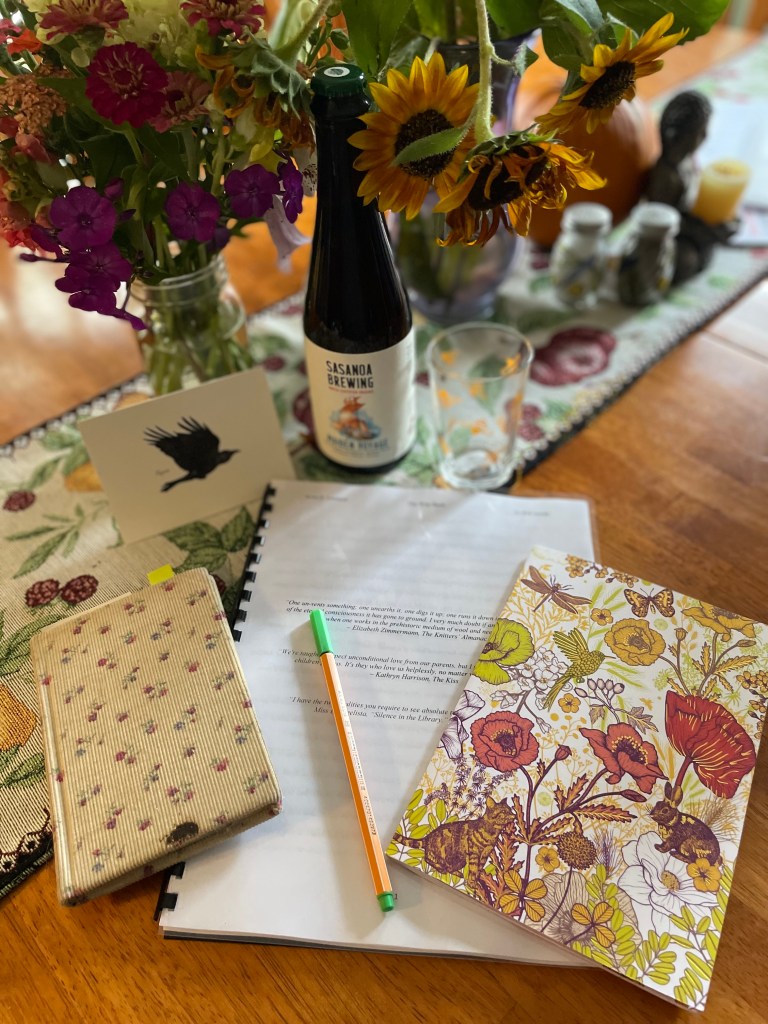
I reframed the whole process of meeting an agent and pitching my book as an experience I would learn from no matter what happened, and I did. I am happy to share that the agent asked to read my book when it’s finished. That ALONE made the whole thing worth it.
As if I got a signed book deal and advance check that very day, I am still cloud walking over my Pitch experience. But the fairy tale ending of my book drafting journey was leaving Pitch knowing that another human wanted to read the whole thing when it’s done.
The problem is that I may never finish that manuscript. At least not as I originally imagined it.
I know how that story goes, and I am tired of telling it. Like a toddler who abandons one beloved bed time book just as you can say it by heart (er… phone it in), and adopts a new favorite (with a million more pages), I am ready for what’s next, too.
I can’t unlive the past, and I can’t change it either. The only hope for growth, healing, new possibilities, different outcomes, and all that moves us forward is right now and what comes from the choices we make (or don’t) in this moment.
So I am writing my whole manuscript again from the perspective of the life I am living in the present. I’m writing as the person I’ve become, who, it’s important to acknowledge, was made possible by all I wrote as the person I was then. It’s a quantum equation of creativity and about as much math as I can do.
“We are all stories in the end,” Doctor Who said. “Just make it a good one, eh?”
I’m getting my Catholic on this holiday season.
I can’t really say I was raised Catholic because for those who truly were, my story falls far short. I also don’t want to trade on pop culture cliches of Catholicism to convey what being Catholic meant to me. I never wore a plaid school uniform because I did not go to Catholic school. I’ve surely sinned, and done plenty of penance. But I don’t recall many formal confessions.
I was baptized late – at age 4 – after my younger brother was born and I was well on my way to heathenism. I am not sure I set foot in St. Mary’s again until I was 7.
I was signed up for Confraternity of Christian Doctrine (CCD) classes so I could make my First Communion on time, likely at the behest of my French-Catholic grandfather, who I called Papa. He took me to Mass with him on Sunday so halfway through I could be dismissed with the Catholic children who had years of religious education on me. We sat in a circle in the basement community hall learning catechism from picture books.
I wrote about some of my Catholic memories many years ago in a column for the newspaper where I worked. The kind of Catholic who probably knew for sure when to kneel and when to stand during Mass came to the office to complain about the column to my editor.
I no longer remember exactly what I wrote, but I still feel ashamed of whatever ignorance caused me to write something that offended that Catholic. I revered Catholics like her who genuflected without hesitation, unlike me. I made the sign of the cross on a two-second delay to make sure that’s what I was supposed to be doing. My face still flushes at memories of making shapes with my mouth because I didn’t know the words to a prayer.
Additionally, an uncle called me to share his concerns when that column ran. He was not even from the Catholic side of my family. But he was the kind of older relative who insisted that because he knew me as a little kid and teenager, he knew me still, decades later – better even than I knew myself. My uncle shared that he had no memories of me going to church with my grandfather.
Interesting. My uncle’s wife – my aunt – was none other than my godmother! There she is in pictures of my baptism holding my younger brother over a gold basin while holy water poured over his head.
My uncle implied I made up my church memories.
It may not have been the Catholic story of my mother, who was raised with all the rites, plus extra restrictions only the French could divine from Scripture. But I didn’t imagine it. How could I forget learning to get dressed and sit still on a Sunday morning after spending 7 years watching cartoons in my pajamas instead?
So I am wary of writing about my Catholic experience at all. I never felt like I was doing it right. So I worry I won’t be able to write about it right. I’m about as clueless as a Catholic could be – or should be if she’s going to call herself Catholic at all.
But I want very much to experience Advent as the spiritual – and for me, Catholic – journey it’s meant to be. It’s not just a chocolate countdown to Christmas.
So I showed up as the admittedly bad Catholic I am at St. Mary’s Mass on Dec. 3, the first Sunday of Advent. I mouthed over prayers, kneeled and stood when everyone else did, and put some money in the collection basket while we sang a hymn.
Afterward, I wandered around the sanctuary admiring the stained glass windows that so mesmerized me as a child. I used to track the light that poured through them at 10 o’clock family Mass, the sun signaling it was about time for coffee and refreshments, a highlight of my early church experience.
On the sill of each window was a necklace of rosary beads formed in the shape of a heart. A card said they were compliments of the Knights of Columbus, but just to be sure, I asked a woman who was passing out fliers if they were to borrow and bring back, or if they were for keeps.
“For keeps,” she said, and told me about a book study group starting soon. She wrote her phone number on a flier and handed it to me.
I chose a strand of purple and green plastic rosary beads with the Virgin Mary on the cross. Somewhere, I know, I have the rosary Papa gave me. That was for keeps, too. I searched my mind for where it might be kept after all these years. I wanted to hold it again in my hands, follow along with the instructions for How to Pray the Rosary, also compliments of the Knights of Columbus.
But all I really had to do to experience Advent as something holy was open my heart. I call forth my own imperfect Catholic story, tucked like a folded note hidden in a hymnal. I didn’t choose it, and there are parts I wish could be changed, but it’s unquestionably mine.
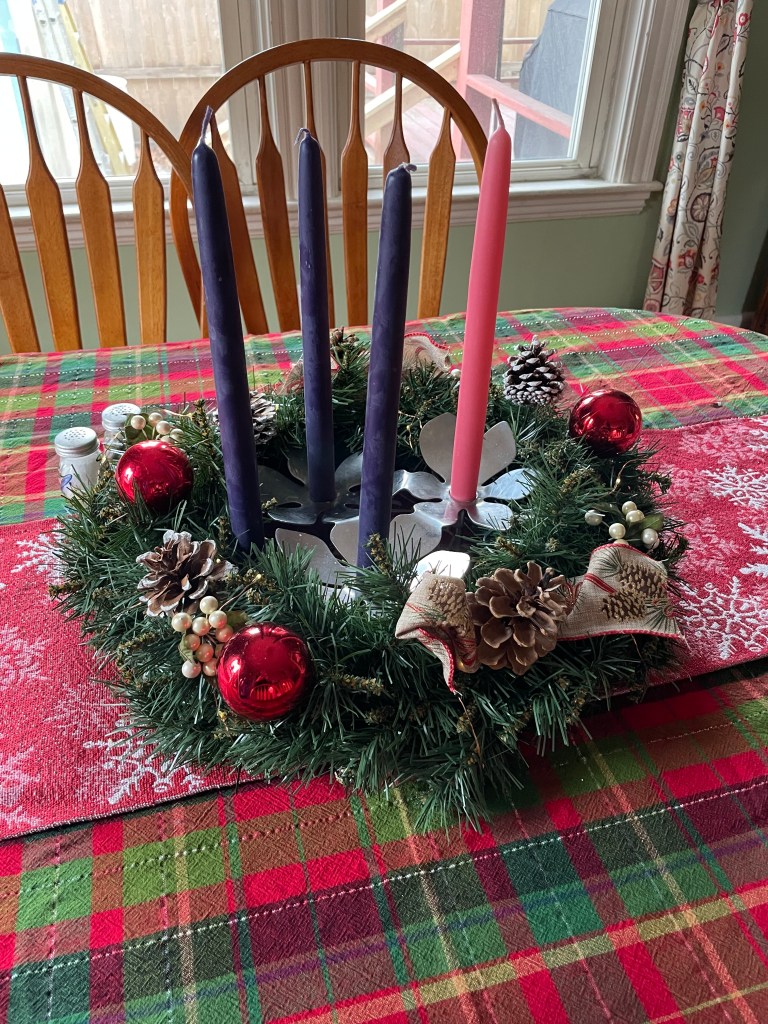
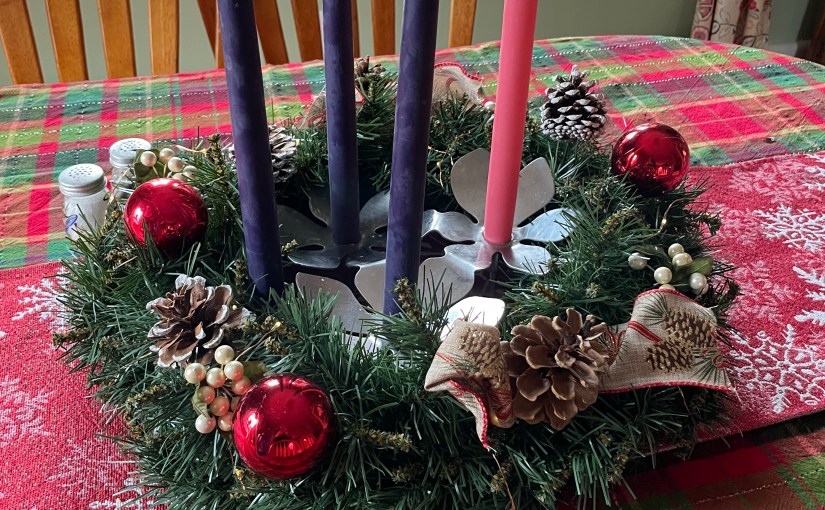
I unfold it now and hold it in the light of Advent. The first candle is for hope.
And I sure hope I am doing this at least a little bit right.
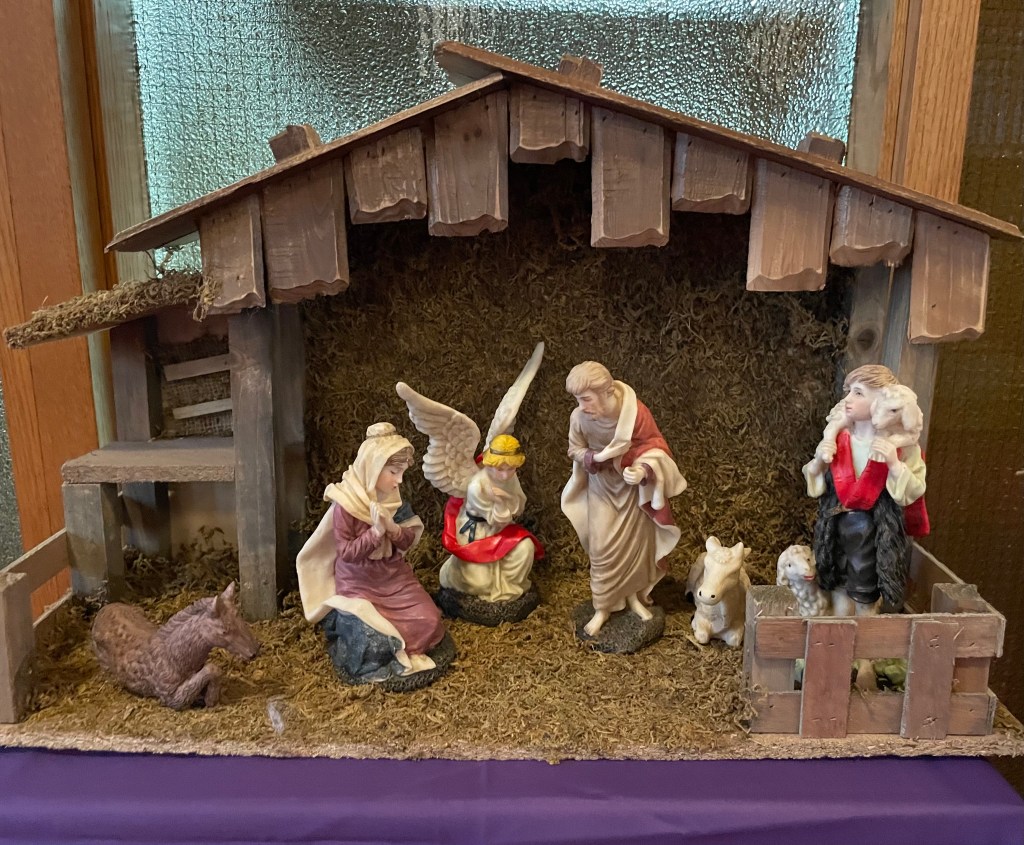
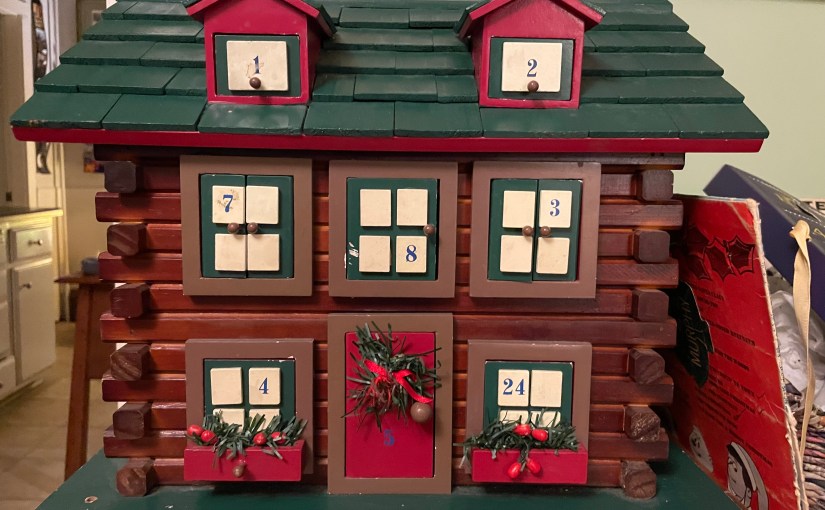
Every year I unpack the log cabin Advent calendar my mother gave us when my oldest son was my only son. I wanted to bring a new holiday tradition to my own little – and soon to grow – family. After a year or so of punch-paper Advent calendars filled with waxy chocolates, a box arrived from one of those mail order specialty gift catalogs.
Merry Christmas, the card read, May this house be full of joy each year. Love, Mom.
Every year it is.
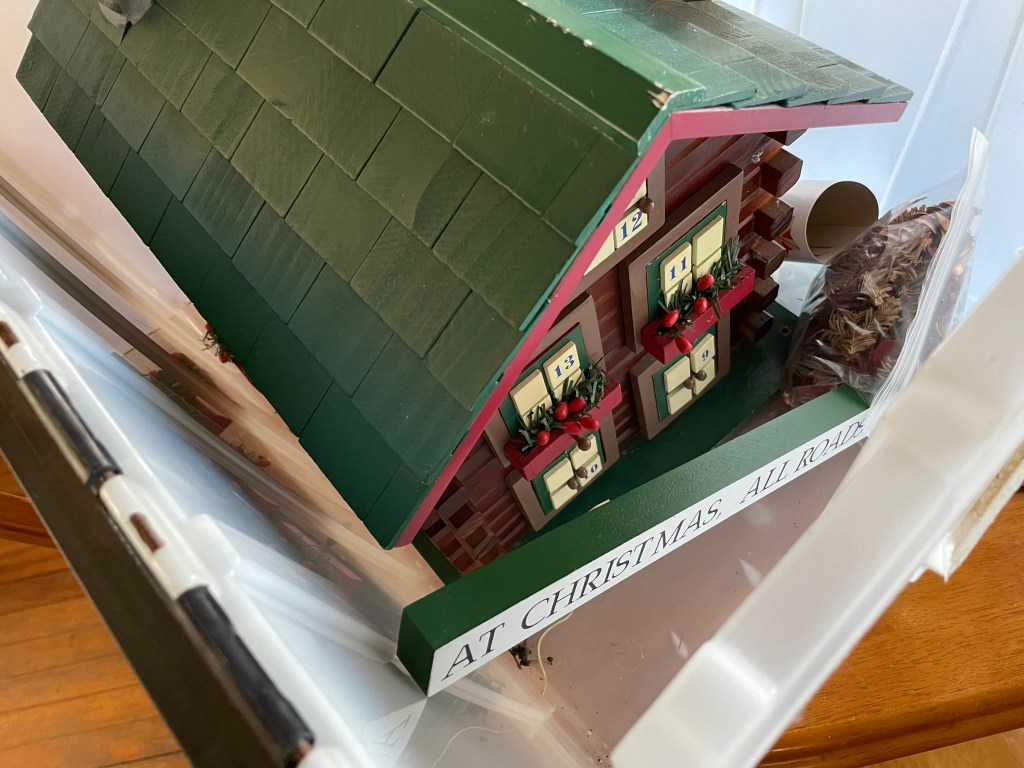
If I go hard for anything at Christmas, it’s the Advent calendar(s). Christmas stockings, too, but that’s a post for a later reflection.
What I love about the Advent countdown is spreading out the glad tidings over 24 days instead of saving all the cheer for Christmas morning. It lasts longer and it may be just that simple. I mean, who doesn’t want more merry?
When my kids were little, I had to be pretty strict about whose turn it was to open the numbered door or drawer of the log cabin. Otherwise they might tear each other’s hair or rip each other’s arms out to be first. Usually, they found foil-wrapped chocolate Santas or ornaments from the Bath Sweet Shoppe, back when a bag of holiday candy – enough to fill the Advent calendar of three greedy little boys (and their stockings, too) – cost about $25.
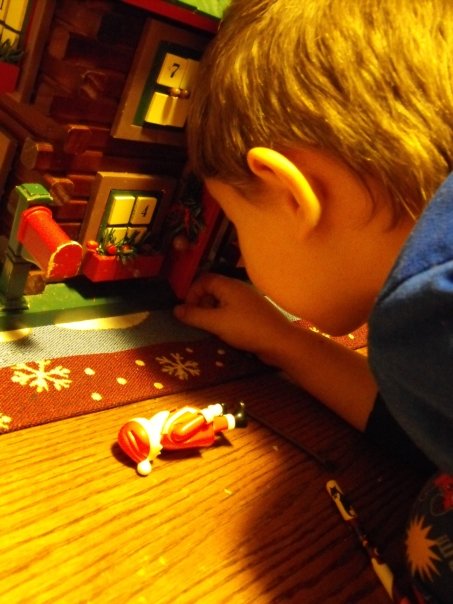
Over the years, the Advent calendar also held other surprises. Playmobil pieces dispersed among drawers as clues to the bigger set Santa might leave under the tree. Legos that built a Ninjago thingie a handful of bricks at a time (yes, my kids fought over these, too). As they grew, each day might be filled with candy leading up to one bigger surprise each week, like cinema tickets the years Star Wars premiered a movie.
There was the year of kindnesses (plus chocolate). I leave one of its prompts behind the door to find over and over again when I unbox Christmas. It’s an evergreen reminder.
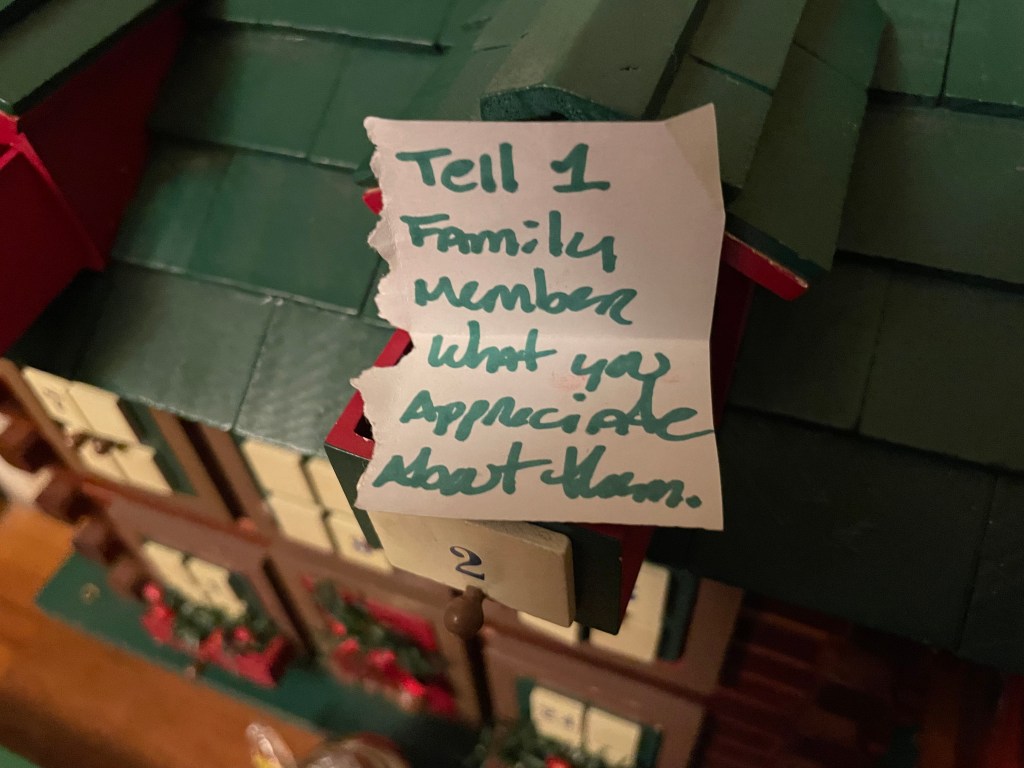
The Advent house is empty now, though I still take it out and set it up. Memories spill from it. I unwrap them in my mind, swallow them in my heart.
The kids are grown up, but I honor Advent anyway. I give them each a punch-paper calendar with slightly better chocolate from Trader Joe’s. These simple cardboard boxes might get tossed in the backseat of a Jeep, tucked in a messenger bag and lugged from one lab meeting to the next. No one’s looking so someone might eat all the chocolate in their calendar in a single day. Another might find theirs in May completely intact under a stack of books.
It doesn’t matter how my family encounters Advent as young adults. I hope, just as my mother did, that when they do, at Christmas, or when they clean out their cars, or in a melted mess in August, they will know how very much they are loved.

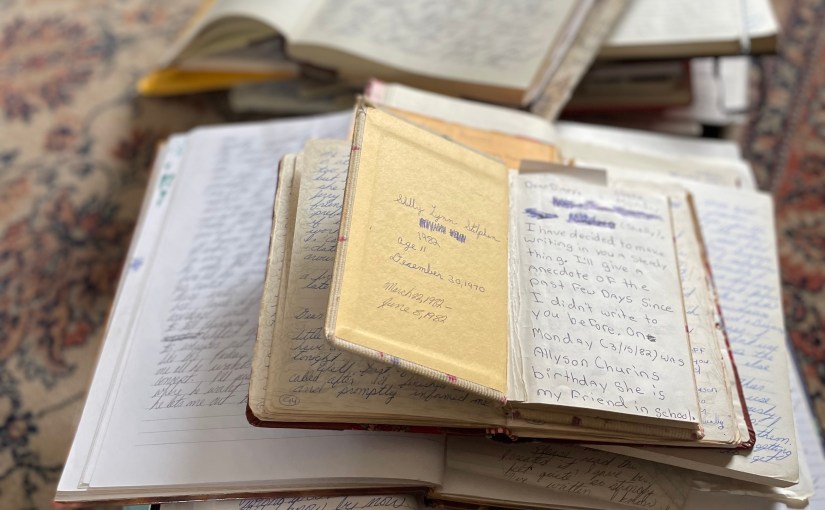
Today marks 41 years exactly since I started talking to myself.
I thought I would commemorate the occasion by starting to draft what could someday be a publishable book. How auspicious to begin such a thing on the anniversary of when all the writing began.
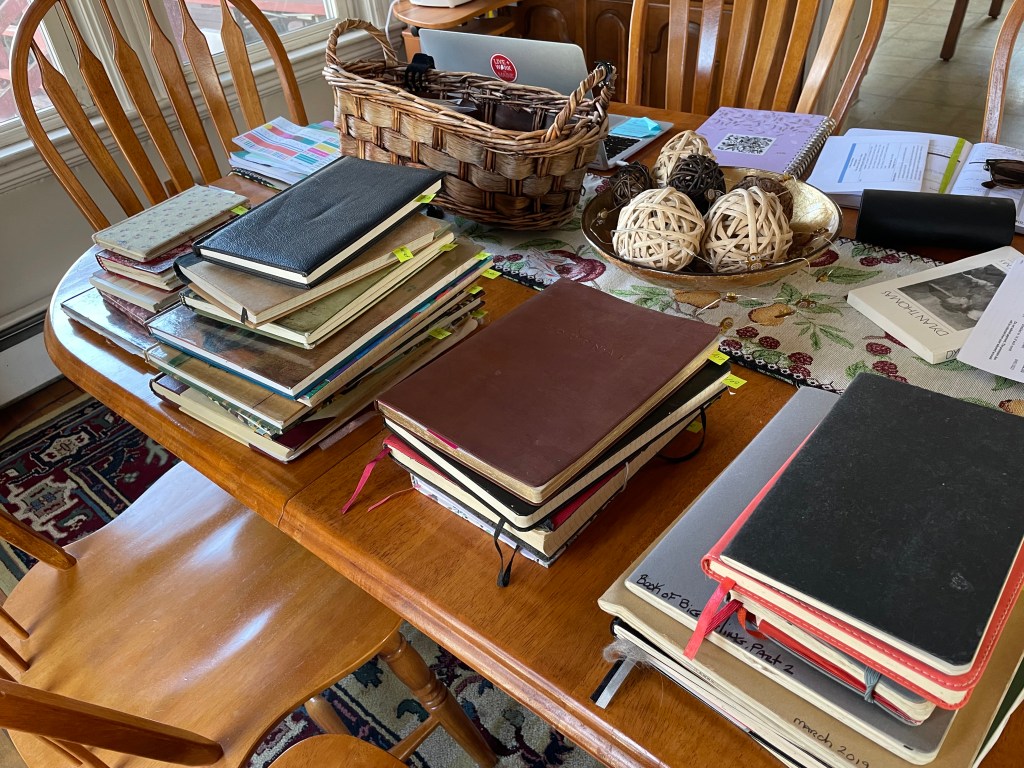
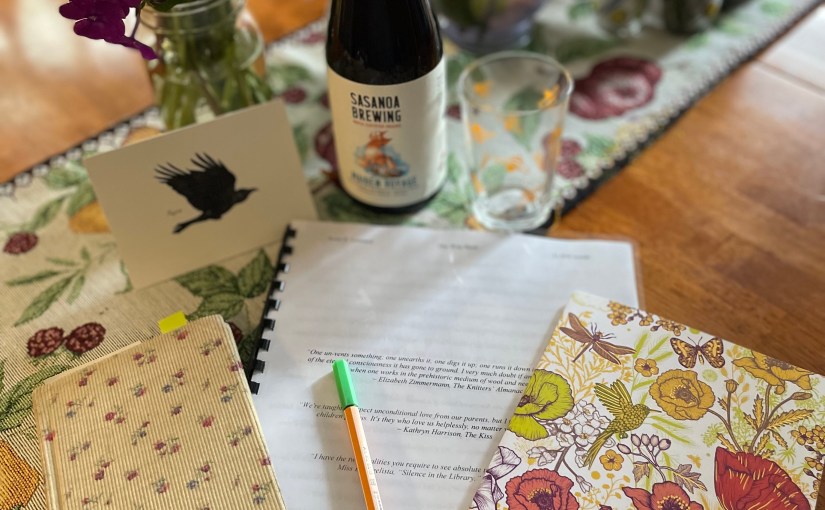
But when you’ve been talking to yourself for so many decades, you can’t just not show up one day without being missed, even if only by yourself. So instead of crafting what would surely become a respectable memoir this morning, I simply picked up the first journal in my spring 2023 series, and wrote a great big long thank you note to the lifelong friend I found between all these lines across so many pages, filling books, stacked in boxes.

As I wrote, I thought, wouldn’t it be cool to look at March 22 (or thereabouts) for every year?
So I pulled all the March volumes and flagged those dates.
Somehow I thought I could whip all of this together and still get to job, but it’s going to to take some time to not only collate all this, but contemplate it.
This is enough for now. This … and some basic opening questions.
Where is 1983 (’86, ’88, ’89, ’91, ’92, ’93, ’97, ’99, 2000, ’05, ’08, ’11, ’14, ’16)?
Who was the “you” I was writing to in the early years?
What is the wisdom – if any – in these old words?
I’ll be listening to myself now.

 Raye S. Leonard