Truth & Consequences

I shared the post about what to do with my 40-plus years of journals on Facebook yesterday, and a childhood friend commented that he was afraid of how he may come off in the words of my 12-13-14-year-old self. His words were kind of jokey – and not as specific as the ones I just used. But you get it, right?

Anne Lamott said, “You own everything that happened to you. Tell your stories. If people wanted you to write warmly about them, they should’ve behaved better.

Yup.

But I want to crack open this idea bit more. Because while I believe I have every right to render my personal experience in all its agony and glory to myself privately, it’s nobody’s business but my own. It’s unpublished for a reason. If I burn it all, that will be why.

I wish I could go through life without needing to document every emotional hang nail and loose the wild banshee of rage over real or perceived injustices on the page, but I can’t. Without the aid of a pen, I don’t know how well I could have adapted to – never mind survived – the dysfunctional systems I found myself in.

Not blaming. Just saying.

However, when I feel moved by the creative spirit to take some raw material from my life and put it out there in the world, I owe it to myself to filter it through rigorously honest self-reflection.

I learned this the hardest of possible ways.

See, when you’ve been writing since you were 11 years old and this new thing called blogging comes along 25 years later, you’re ready. You know exactly how to do that thing.

My blog was called “Bad Mother Chronicles” and I posted about everything in my life as a mother of three young kids. It grew very popular. Alltop syndicated it. I was interviewed five times by the BBC’s “World Have Your Say.”

So I wrote another blog called “Love On The Run” during my divorce from my kids’ father. Same “breathtaking honesty” (one of my most treasured compliments), but the truth had consequences this time. I got actual hate mail that included the suggestion that my kids would be better off without me.

I went scuttling back into the pages of my private journals and stayed there for over a decade.

(Sort of. It wasn’t God’s plan for me to not be a writer in the world, so I had the miraculous good fortune to work a series of jobs at newspapers that included writing narrative columns. But as for “baring my unedited soul” for all to see, that was good and over.)

It’s taken 12 years, but I understand now what happened with the blogging, particularly Love On The Run. I did not lay upon my personal experience any self-reflection at all. Not like I should have. Not like I do now.

At the time it was deliberate. I had gone looking for divorce narratives that expressed the experience as it happened and not as a retrospective memoir. I didn’t find any, so I wrote my own, figuring others might benefit from my experience. That’s the old blogger spirit!

But I can see how it probably came off as a shameful, attention-seeking, heedless-of-the-hurt-it-caused, self-promotional tell-all.

Oh man, do I get this. Lately, I get sucked into certain family influencer Tic Toc reels. There’s one with a dark-haired newborn and a caption that reads, “When your whole family is blonde,” and the parents looking askant.

Really? How’s that baby going to feel when she sees that someday?

I wish I could tell this new generation of “everyday reality” content producers that it turns out there are some life experiences that merit every ounce of contemplation we can bring to them before we render them for consideration by anyone else, especially when those experiences include others, and most particularly when they involve our children.

Self-reflection is a form of revision. It asks questions, considers alternatives, balances accounts, seeks the source, goes a step (or fifty) further, gives shape and form, and makes choices – what to leave in and what to leave out.

Working at newspapers taught me this, too. A reporter owes her subject an accurate rendering. It’s the highest ethic. And it takes time, thought, and work.

Discernment is essential to good reporting. You gotta trust your hunches. But you have to check them, too. A story that sounds good to your ear may not be the one that’s closest to true. So you listen longer, swap your eyes for another’s. And beware those stories that “just seem to write themselves.”

Like my journals.

There are plenty of folks – most of whom I dearly love – in those thousands of pages who I don’t treat warmly all the time. I don’t have to when I’m writing for myself.

But when I am writing from my life with the intention it will be read? Most of all, I want to be fair. No one is all good or all bad, even me (despite what my 17-year-old self believed).

I don’t know if words really live forever on the internet, or who would ever bother to collect (or recall) them all.

But I do know that words can linger far too long in the heart. And so they must be wise ones, and whenever possible kind ones, and most of all worth the consequences of the truth they claim. A spell once cast cannot be un-cast, after all.

I was never a “gotcha” journalist, but I am relentlessly (perhaps annoyingly) curious. I want to understand … why you are the way you are, why what happened happened the way it did, why it happened at all, HOW it happened, why I am the way I am, and what might become of you, of me, of any of us.

I’m just trying to make sense of the world the only way I know how.

Should my childhood friend be worried?

I guess he’d better behave from now on.

(I found some amazing Anne Lamott quotes here. Not the one I used, but all the rest of the best.)
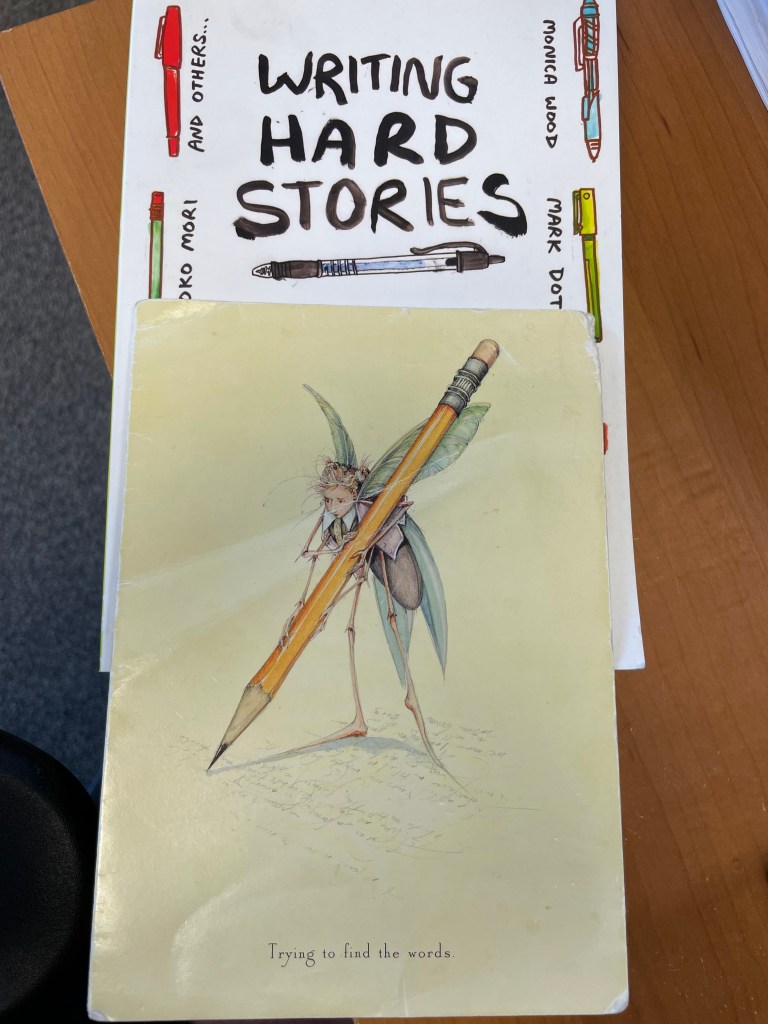
My mother gave me this card about six months before she died and I still carry it around with me 17 years later. I lost track of it last year, but found it in this book by Melanie Brooks. I must’ve used it as a bookmark.

40-plus years, and counting

Was this a stocking stuffer for Christmas 1981?

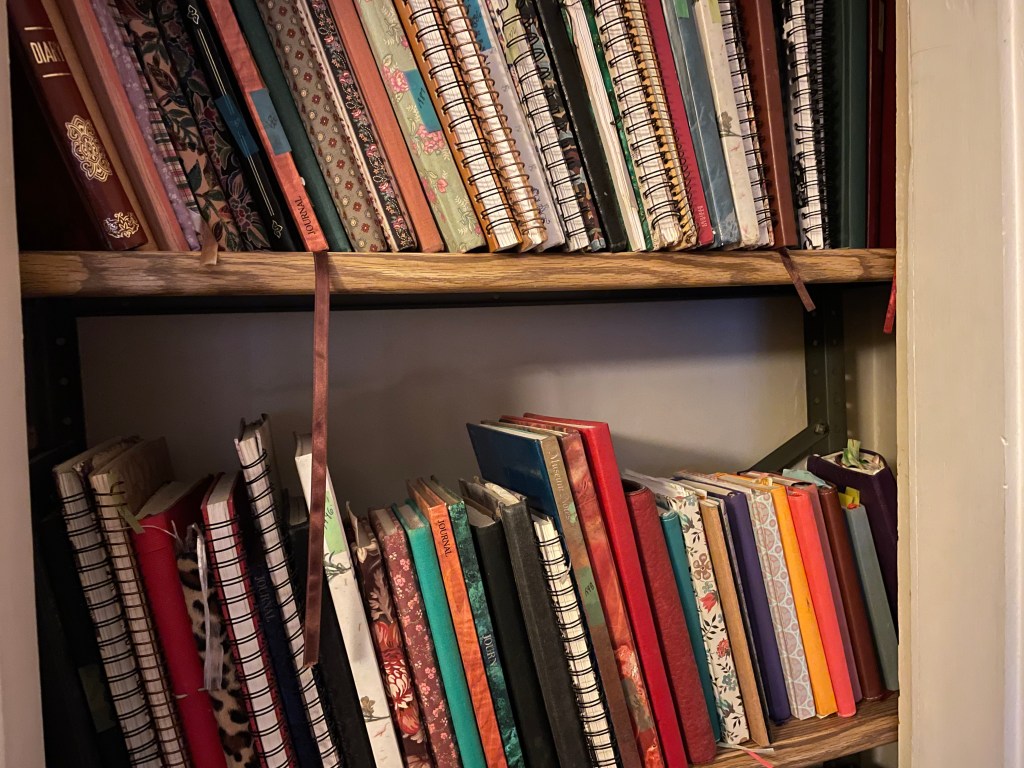
Last March, I marked 40 years of keeping a diary or journal almost daily. It’s so foundational to who I am that diary or journal doesn’t quite capture what the practice means to me, it’s impact on my life at any given stage, and how it’s shaped who I am. Or should I say who it’s been possible for me to be?

I did not mark the occasion last March because I missed it. I missed it because I had it in my head that the 40th anniversary of my journal keeping was in MAY (1982).

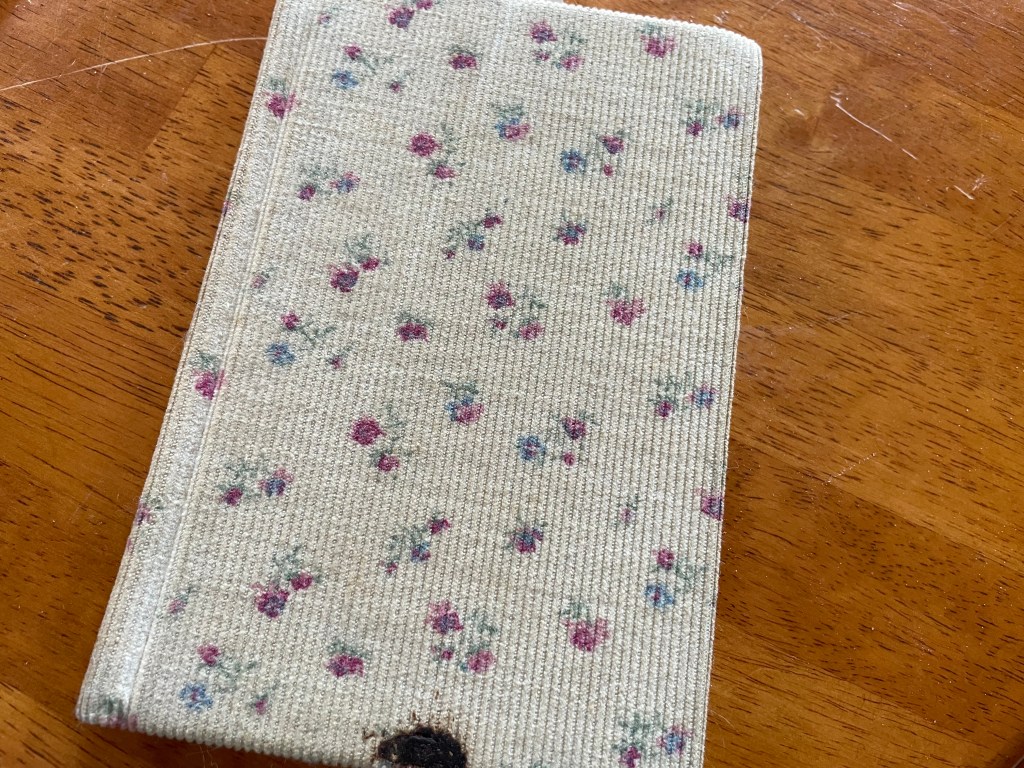
So in MAY 2022 when I pulled out that first flowered corduroy book to reflect on the milestone, I was surprised to see I’d missed the actual day!

Humble beginnings

And by May of last year, I was dribbling off the table of the newspaper career I had ping ponged into the summer before. I was in transition (again), and not in a reflective state of mind.

So I put that inaugural volume of personal writing back on the shelf and walked away.

Volumes from the early days.

How could I miss it? At the time, I shrugged it off because I didn’t want it to be the very big deal that it was. You do something nearly every day for 40 years and you’re only just 51 at the anniversary of it, and you miss it?!?

I don’t know what I had in mind to do to celebrate, but I wanted to do something. I wasn’t looking for a party so much as a ritual to honor whatever inspired me to think writing was something I could do, and for continuing to do it pretty much no matter what. That’s sort of heroic, right?

There is no trophy or prize, but in my acceptance speech for the privilege of having a writing practice, I want to thank God, the Universe, every single teacher I ever had who fanned my flames, all the readers of various projects who sent me notes, students who shared their own stories, and everyone everywhere for all time.

What’s been published is maybe an eighth of what I’ve actually written, but it was enough to help me imagine a writer is something I can be. Maybe even more than that. I writer is something I am.

I would say more lest you get the idea that I think I am “all that” because I’m a writer. But that’s a new thread that requires much additional narrative stitching.

I suppose I am just in time for the 41st anniversary of keeping a journal in about a month.

But more than marking the day an 11-year-old child first picked up a pen, I want to do something with this enormous body of work. It’s just piled up … well, like dead bodies … for over 40 years.

What do you do with decades of diaries? I’d hate for just about anyone to ever read them. I know intimately, painfully, and life-alteringly the cost of someone else rummaging around in my private pages, assigning their own meanings to my experiences, and punishing me for the offense of telling my stories to myself.

Better to burn the whole lot than ever go through that again.

But how can I do that to all the people I’ve been? The child who recorded what she ate at a family cookout? The lovelorn teenager. The young woman lost in the missing years. The new mother, grieving daughter, valiant single parent making ends meet as a college adjunct, scrappy community journalist.

I may be the only one who can read their stories with true compassion, now that I am not them, and yet all of them combined.

Those are not just books on the shelves. They are whole lives. I lived them. And they await my kind eyes.

More recent volumes.

Sun, shade, water, weed

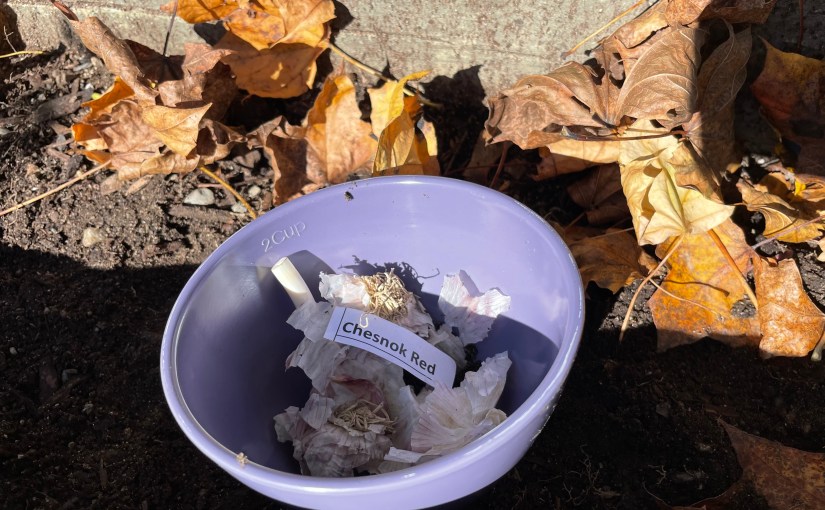
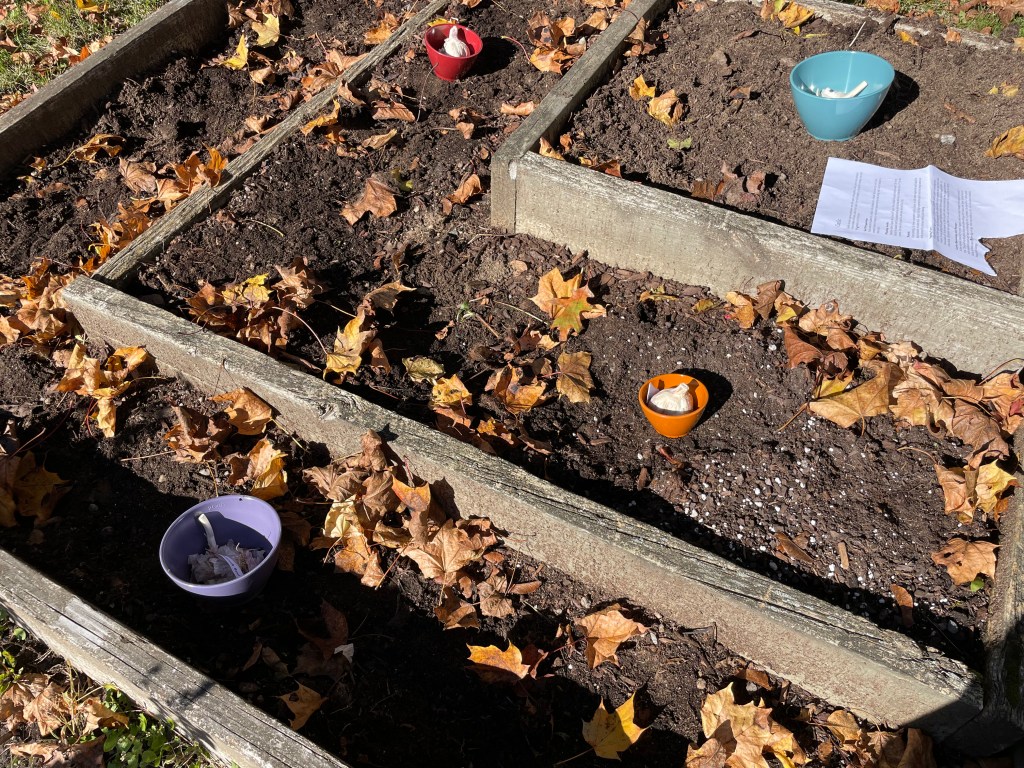
I planted garlic today. Four types. Georgian Fire, Chesnok Red, Russian Red, and Spanish Rojo. I know nothing about what makes one type of garlic different from another. I chose them because they all looked plump and evenly papered in their separate bins at Moose Crossing.

I’ve never grown garlic before.

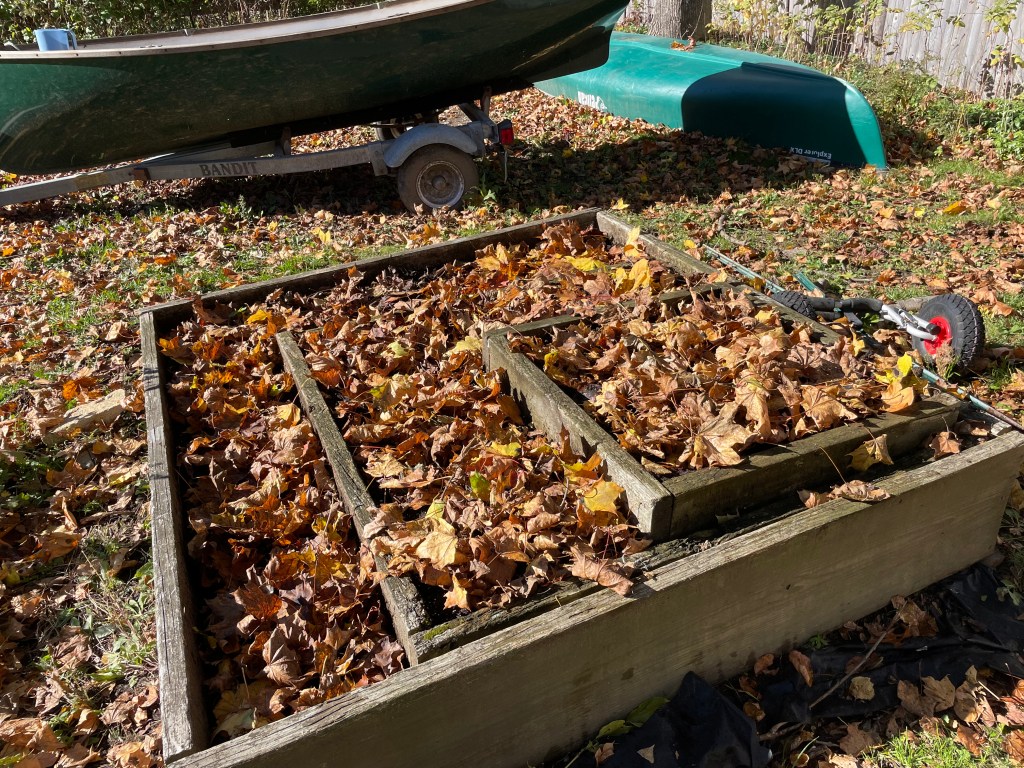
There is an old tiered raised bed in the yard that suddenly gets a lot more sunlight since I had the trees along the fence line trimmed in June. I planned to scrap it, but I am glad I let it go another summer sheltering a flourish of weeds.

Former home of cat grass, catnip, and assorted weeds.

Maybe someone shared pictures of their garlic in a Facebook gardening group I belong to, and I thought it seemed easy and like a good idea.

Over the summer I stumbled upon various articles about growing garlic that confirmed it was probably a crop that wouldn’t be destroyed – not by any number of natural disasters, but by the dull scythe of my own ignorance.

See, I’m not much a gardener. For many years, I bought whatever looked pretty, read the plastic stick or the back of the seed envelope, and did whatever it said. Sun, shade, water, weed.

And then?

Grow or don’t. I was elated when flowers and vegetables blossomed, but it was nothing personal when they didn’t. I usually work all summer and I am more drawn to the ocean in my spare time, so if my landscape looked like the gardens of the dead by August, well, there was a reason for that.

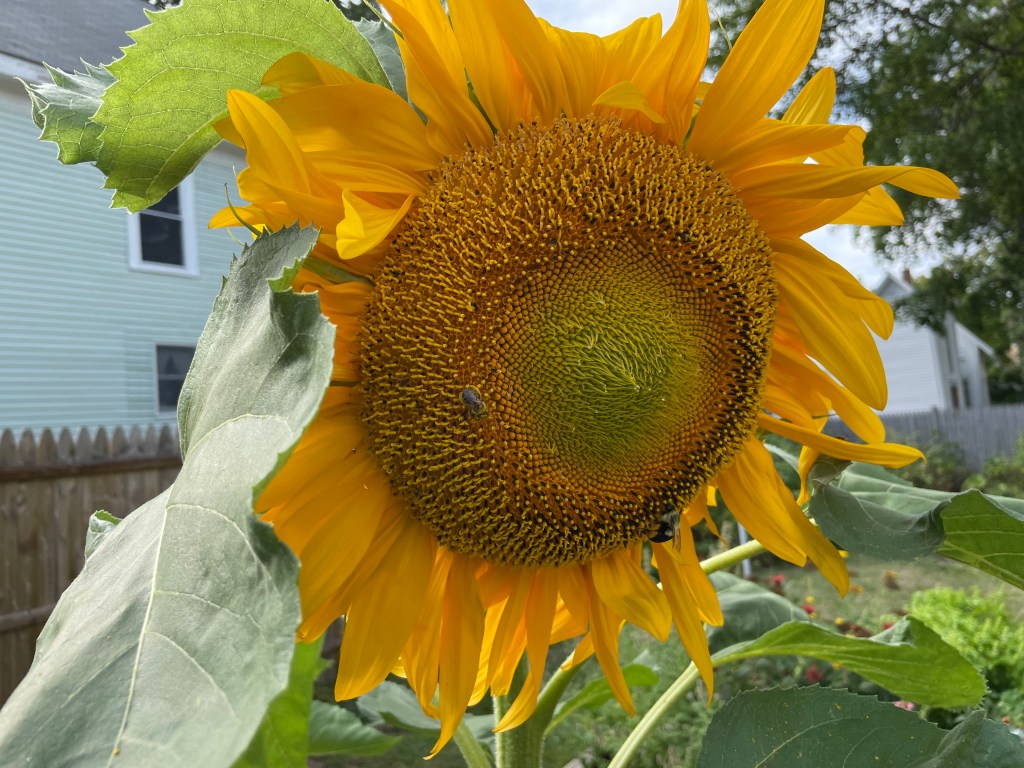
I started growing sunflowers in 2020, and had amazing success.

Those pandemic sunflowers with their beautiful faces.

That’s when I started to think maybe I could be a “gardener,” and not just someone who “grows things.”

Now I plant sunflowers every year. I wait for them expectantly like relatives who live far away and only come back in August. Once their flower heads form, I check their faces every day to see if they’ve finally arrived. When they do, I kiss them all over like an ecstatic aunt.

2022 visit: Clearly, we are “sisters from another mister,” right?

I don’t know if I will have the same familial relationship with garlic. But what I do know is that carefully preparing the raised bed for something better than weeds feels hopeful.

Maybe it’s not great big hope. I really don’t have a whole lot riding on my garlic garden. There is no make-it-or-break here for me. And I will probably always lean more to the grow-or-don’t end of the gardening spectrum.

But planting something in these diminishing fall days for a future in the lengthening ones of summer feels like I have something to believe in. There is more to look forward to than turning the calendar pages this winter in the endless wait for spring.

There’s garlic!

Mulched with leaves, hope awaits its future scapes.

***************************************************************

I fully intended to do the Write 31 Days challenge like my last two posts suggest, even though I started it late anyway.

I began a new job as an adult education director on Oct. 3 only to test positive for Covid that night. I lost two weeks to the infection. Though I believe my case was relatively mild, it took 14 days to get a negative result (during which time I opened my blog again and started poking around).

Since I finally went back to work, I’ve been busy cramming a month of career transition and a backlog of student intakes into the last two weeks.

While I abandoned Write 31 Days, it turns out that popping a few posts up on your blog is a kind of creative self-seeding. Ideas for things to write about keep coming to me. Reflections, recollections, records of what I find interesting or meaningful.

It was also cool that when my middle son asked me for my baked mac and cheese recipe, I could say, “It’s on my website!”

November is National Novel Writing Month, and while I have no intention of trying to write a book, I do have a new daily goal of writing something.

A blog post every now and then might be one of them.

Write 31 Days: By heart (Day 2)

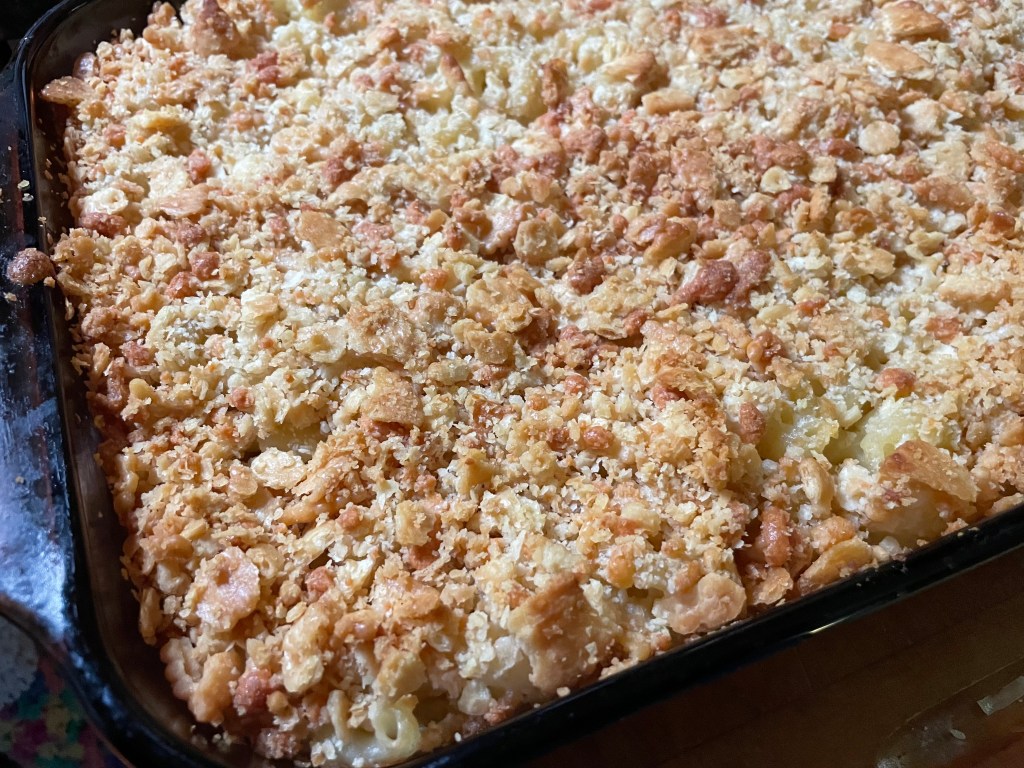
I made baked mac and cheese for dinner tonight remembering the recipe off the top of my head.

That’s such a funny phrase. Typically it suggests saying something without giving it much thought. You could also say what’s your knee jerk? Or your gut reaction.

It’s like the body is a consultant more trustworthy than whatever well-reasoned sentence might come out of your mouth if you took a moment to construct it. There’s your gut, your knee, or the top of your head saying or doing something totally different. And possibly more believable.

So let’s say instead that I whipped up a baked mac and cheese with a recipe I know by heart. That’s a more accurate idiom.

When you know something by heart, it means it’s part of you, like a freckle, a chipped tooth, or a fond scar. It’s more than a memory for it is not just something past. It is also present in the moment of indelible recall. And future as it calls forth its latest iteration.

Gah. What am I doing? One of my biggest internet pet peeves is wading through lots of words to get to a recipe. I could, of course, go on and on.

I know you’re all ears, but I won’t do that to you.

Baked Mac & Cheese

(A fusion of my Nan’s recipe and Emeril’s … with a little bit of my own laissez flair)

Baked mac with a crunchy top

1 stick unsalted butter

1/2 Cup all-purpose flour

3 Cups milk

3 Cups shredded cheese (I use a combination of whatever is in the fridge, but sharp cheddar is excellent, and a bit of mozzarella makes it creamier)

Salt and pepper to taste

1 lb. small elbow macaroni or shells

1-2 tubes of Ritz or other buttery crackers, crunched up

3 Tbsp. melted butter

Preheat oven to 350 degrees. Butter a 9X13-inch pan. Cook pasta according to package directions.

Melt stick of butter over medium heat. Slowly add the flour, stirring with a wooden spoon. Cook for 2 to 4 minutes, stirring constantly. Slowly whisk in milk, and continue stirring until thickened. Add salt and pepper to taste.

Add 2 cups of cheese and stir until melted.

Drain pasta and return to the pot. Pour cheese sauce over it and mix well. Spread in the buttered baking dish.

Mix crushed crackers with melted butter and remaining cup of cheese. Sprinkle thickly over the mac and cheese.

Bake for about 30 minutes or until bubbly and crispy on top.

Enjoy!

Write 31 Days: No bad eggs (Day 1)

I was in my late 40s before I knew that “bad egg” was not just what you might call an unsavory character. There really is such a thing as a bad egg, an egg that’s gone bad, that you shouldn’t use, and if one makes its way into a recipe, there’s no going back. You should start over with all the good eggs.

I’ve been cooking and baking since late adolescence when, on some subconscious level, I fully incorporated an understanding that the ability to turn out a satisfying meal was my ticket to doing something not just acceptable, but valuable.

But until I did an online whole foods freezer cooking class with Heather Bruggeman in 2016, I never met an egg I didn’t like.

Heather cracked eggs into a separate cup before adding them to the main mix. I knew this was a thing, but to me it was just something some people did for their own personal reasons. I was just not that fussy. Everyone has their own moves in the kitchen. Did it really matter how the egg got in the bowl?

As it turns out, yes, it did. Heather explained that the yolk of a bad egg breaks when you crack the shell. That’s why you do it in a separate bowl. So if the yolk is broken, you can toss it out. Only the best eggs make the batter.

I never knew.

How many bad eggs have I baked into cookies and cakes over the years and served to unwitting family and friends? No one ever said they got sick from my pastries. At least, not that I know of.

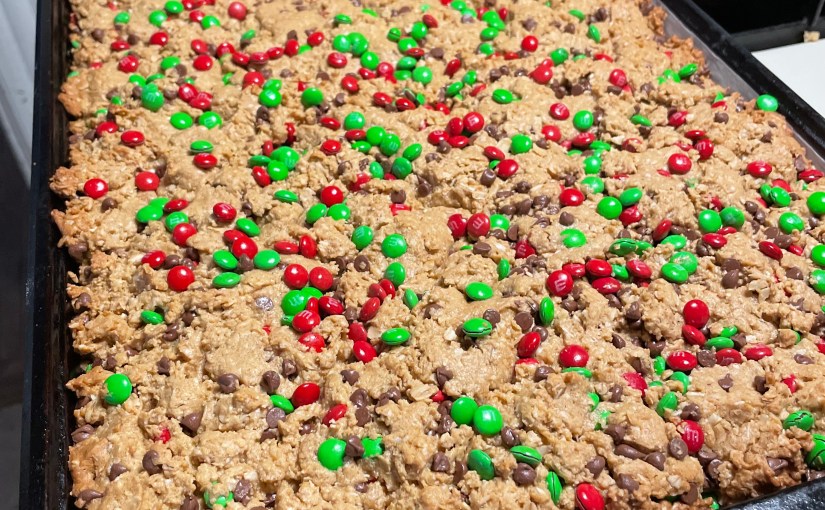
Is there a bad egg in these Christmas Monster Cookies?

I thought if the yolk broke when I cracked the shell it meant maybe the shell poked it on the way out.

My idea of a bad egg is a rotten one. One that smells awful and is therefore obviously no-brainer bad.

I made scrambled eggs for breakfast this morning and one of the yolks broke as it settled in the pan. I scramble hot rather than in advance because I like the somewhat separate streaks of white and yellow in my finished product.

I noted that the egg might be a bad one. I ate it anyway and survived.

I ate it anyway because if my two grandmothers never cracked eggs into a separate bowl before adding them to whatever they were cooking, why should I?

Maybe for us there are no bad eggs. Or maybe we just know a bad egg when we see – or smell – one.

I am sure nobody wasted any eggs in either of my grandmothers’ homes. I like to think that if a rotten smelly egg found its way into a mixing bowl, they would throw it out and start over. I would.

Short of that, there are no bad eggs.

Write 31 Days

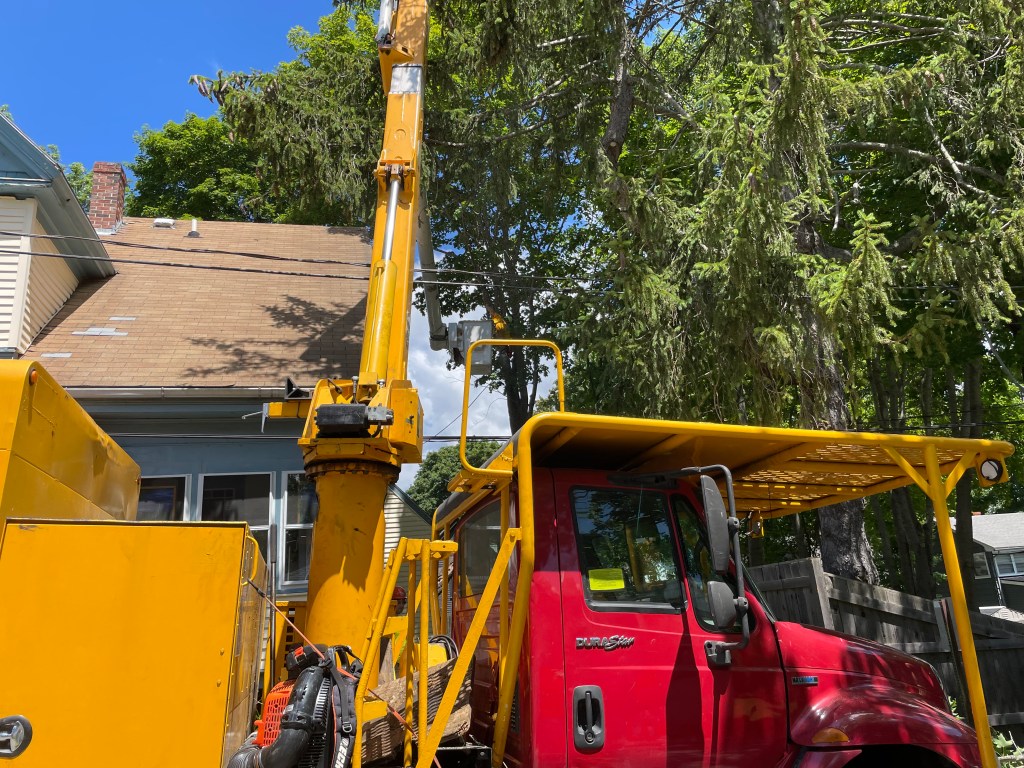
Tree work completed in May at my home, which is undergoing several updates.

A lot’s been swirling around inside of me for the five-and-a-half months since I last wrote publicly. It’s not that I had nothing to say. I had plenty. But words that seemed so solid in my mind transformed to smoke when I tried to set them on the page. I gave up all but my most private writing practice and settled into a fallow time.

Lately, I’ve been trying to find a way back to writing in the world. I’ve been forgetting and remembering how to do this my entire writing life, always certain I’ve finally lost my way for good.

Fortunately, it has a way of finding me.

Yesterday the blogger of A Moveable Garden shared one of her Write 31 Days posts on Facebook. She is simply writing about what she learns each day.

I thought, oh hey, I can do that. I can pick one thing and explore it. My swirling unsettledness is mostly around ideas/beliefs/longings/musings and experiences of home. That will be my thing for the next month.

Yes, obviously, I am very late to this blog party. But as F. Scott Fitzgerald said,

“For what it’s worth… it’s never too late, or in my case too early, to be whoever you want to be. There’s no time limit. Start whenever you want. You can change or stay the same. There are no rules to this thing. We can make the best or the worst of it. I hope you make the best of it. I hope you see things that startle you. I hope you feel things you’ve never felt before. I hope you meet people who have a different point of view. I hope you live a life you’re proud of, and if you’re not, I hope you have the courage to start over again.”

‘Don’t let your self-care stress you out’

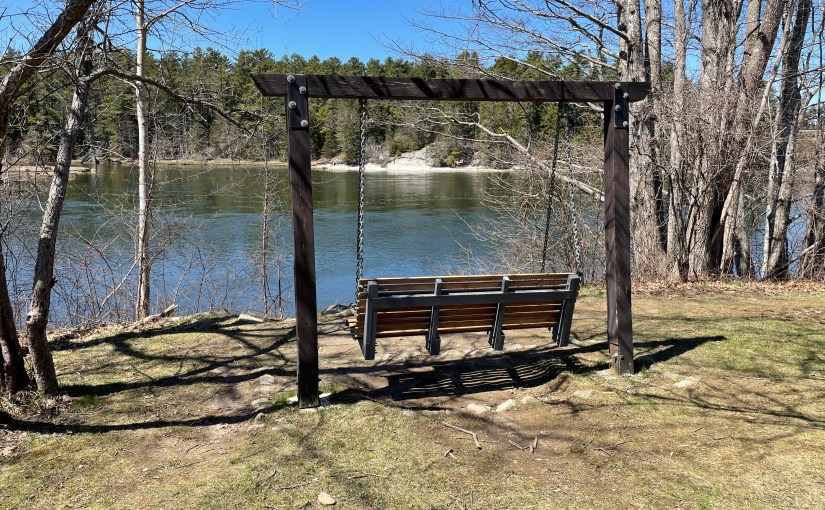
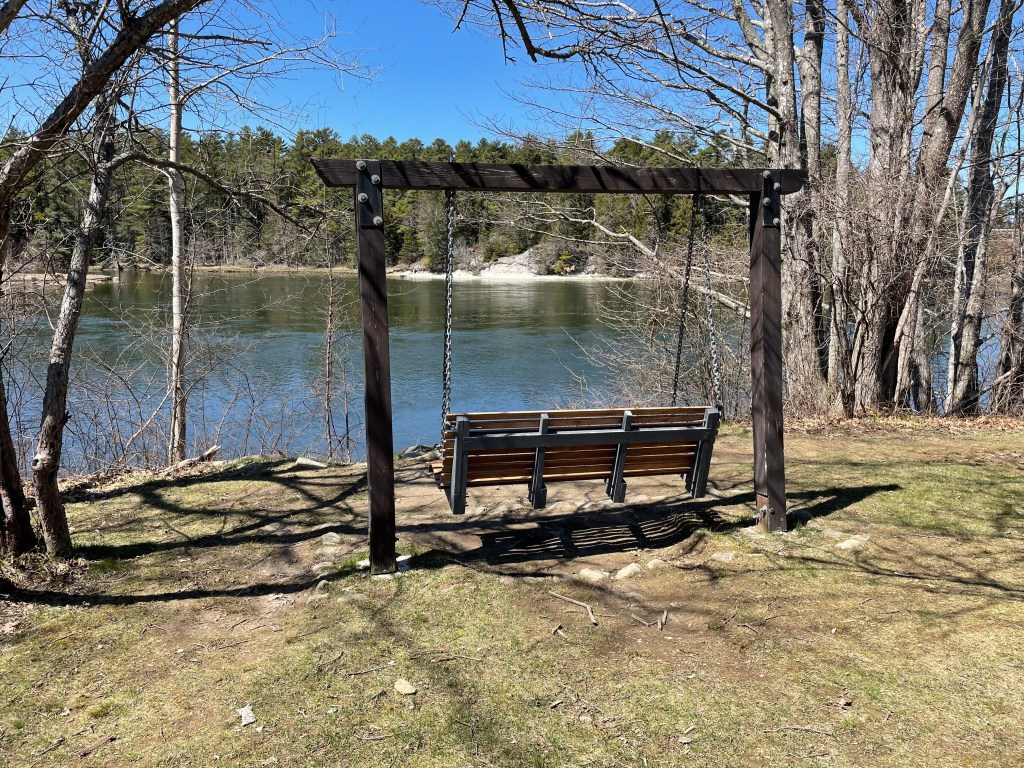
The premium do-nothing place in Damariscotta is the swinging bench at the Whaleback Shell Midden. It is often occupied, but on the off chance it’s open, a half hour spent watching the river go by is worth the wait. (Raye S. Leonard photo)

Broken birdsong. Branches, unbudded, striate the sky. The bench swings slowly back and forth at the Whaleback Shell Midden in Damariscotta.

I need to do nothing.

This is as good a place as any in Lincoln County to lie back, look up, let go.

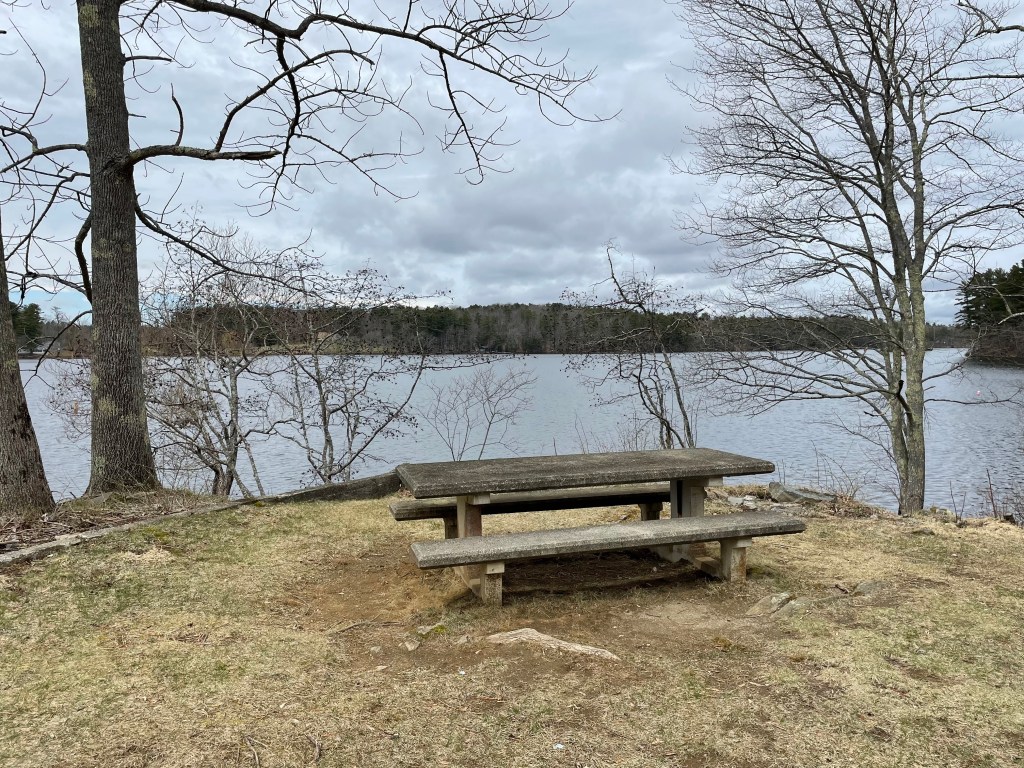
The picnic table on Bunker Hill in Jefferson is another. So is the one at Ice House Park at Damariscotta Mills. Of course, the Pemaquid Lighthouse in Bristol.

But I need places I can get to shortly when I take a break to do nothing. Pemaquid involves planning – and driving – and all that seems more like something.

I spend a lot of time thinking about how to do nothing and what counts as nothing in the great schematic design of downtime.

Downtime. My doctor’s recommendation for the cumulative effects of stress.

Because all the self-care in the world isn’t calming my nervous system.

Panic sneak attacks me at the grocery store, when I brush my teeth, eat toast. It startles me at work, when I am editing, replying to emails, or savoring a homemade lemon roll in the shop kitchen.

It comes out of nowhere. Yet I know it’s always there.

The seizing terror of breathlessness, followed by needing to think about breathing, like the part of me that makes it automatic has a glitch and I need to do a manual override.

I have to stop whatever I am doing to inhale.

Exhale.

Breathe.

There is nothing physically wrong with me, I learned, at my routine annual exam. That affirmation of health reset the glitch for a hot second. Then it came back again folding laundry.

If you’ve never had a panic attack before, it’s like this:

You are minding your own business, say, by a stream (a metaphor perhaps of everyday life). You’re doing your routine thing, whatever that is. Then someone sneaks up behind you and shoves your head under water and holds it there for no good reason (not that there’s ever a good reason). And you swallow your breath because your amygdala took over and that reptilian part of your brain is wired only for your survival.

Except no one did this to you. It just happened.

One minute you’re feeding your cat, and the next, you are sitting beside him stuck to the kitchen tiles remembering inhale, 2, 3, 4 … exhale, 5, 6, 7, 8. You get up when you can swim again, but you can’t shake the feeling that it’s coming back for you.

What’s “it” and who knows when? Maybe while you’re matching socks or peeling potatoes. You stay primed for the next siege. You’re stalked by your own dislocated psyche, swishing its tail for the next chance to pounce.

All of which makes it hard to do nothing. Got to stay ahead of the huntress.

I take walks, keep house, solve Wordle, Quordle, and Spelling Bee. I cover the news, an ultimate busy maker.

I lay down my mat once in awhile at Lulu’s Barn on Westport Island to do yoga with alpacas, whose heads peek through the window between the barn and the fairy house studio. Their outsized teeth smile at me from Seuss-creature faces.

But at the moment, with more effort than it should require, and with great intention, I do nothing.

Except glide back and forth on the Whaleback bench, breathing in, breathing out wet earthy spring.

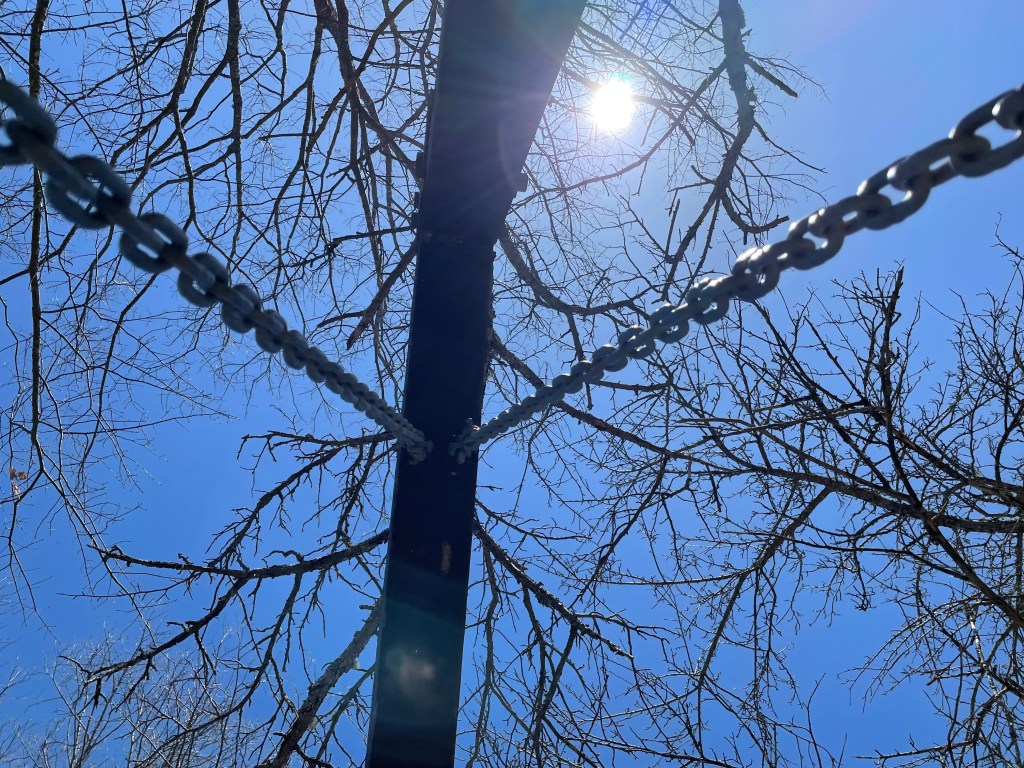
April sun through the trees and chains of the swinging bench at Whaleback Shell Midden in Damariscotta. (Raye S. Leonard photo)

What looks like a harbor seal camouflaged by the blanched oyster shells on the midden across the river suns itself on a somewhat submerged rock until it picks up its head to watch a boat trawl past.

“Do you see it,” a woman with a bowser dog on a leash asks me. She’s stopped to let the hound sniff

in the wet leaves. So many people I meet in Lincoln County speak to me in this familiar way, as if we’ve been having a conversation all along, even though we are complete strangers.

“I do,” I say.

“He comes here all the time,” she says.

It’s a good place to do nothing, even for a seal.

When I get back to my office, I will Google “seal medicine card.” I’m always curious when animals cross my path, especially ones I do not expect to see. I am open to all sources of information – from creatures, clouds, striped stones, sand dollars found along the way.

It’s tricky to verify tips by a subject like a seal, but I “fact check” reflexively.

According to whatismyspiritanimal.com, “Seal arrives with the message it’s okay to take pause and move away from all the chaotic ‘noise.’”

A-ha. Yes. My body will corroborate this story with a bone deep sigh.

What is this “noise”?

I am hard pressed to come up with any single reason why I am on this safari of personal distress. My righting reflex fails me now for as soon as I say, oh yes, this or that one thing is the reason I am so off balance, here let’s fix it, 20 other things queue up and crack their knuckles for the chance to strangle me.

I rattle off all the many possible reasons why to my doctor.

She settles on one that I missed. Pandemic stress.

I guess I am reluctant to excuse the general, yet mostly manageable anxiety, I’ve lived with all my life – obviously in overdrive lately – because people died and are dying still in this bleak time.

I’m a lucky one. COVID washed over my family in the omicron surge, and though held down by the wave for a couple weeks, my two kids and my husband who got sick came up again.

Are random panic attacks really that big of a deal compared to the grief of those who lost people to the scourge of SARS-CoV-2, or who struggle now with something called “long COVID” (signs of which I am on constant alert for in my family)?

I learned well growing up that regardless of my own discomfort in any given moment I should think of others less fortunate, and be thankful (happy even) with whatever ultimately meaningless (in the greater scheme of things) situation I might face.

I had to learn this because I was born “spleeny,” my mother would say. Everything was too hot or too cold, too scratchy, too tight, too loose. I was never comfortable. If there was something wrong, I’d find it, and make it my personal problem, amplifying it to anyone who would listen; until I accepted that my sensitivity to even the slightest grievance (real or imagined) could be tuned to consider others far worse off than I.

It took my mind off my own troubles. Never mind what I needed to do for myself. How could I help someone else?

Now, I think of others automatically … the way I … well, the way I used to breathe.

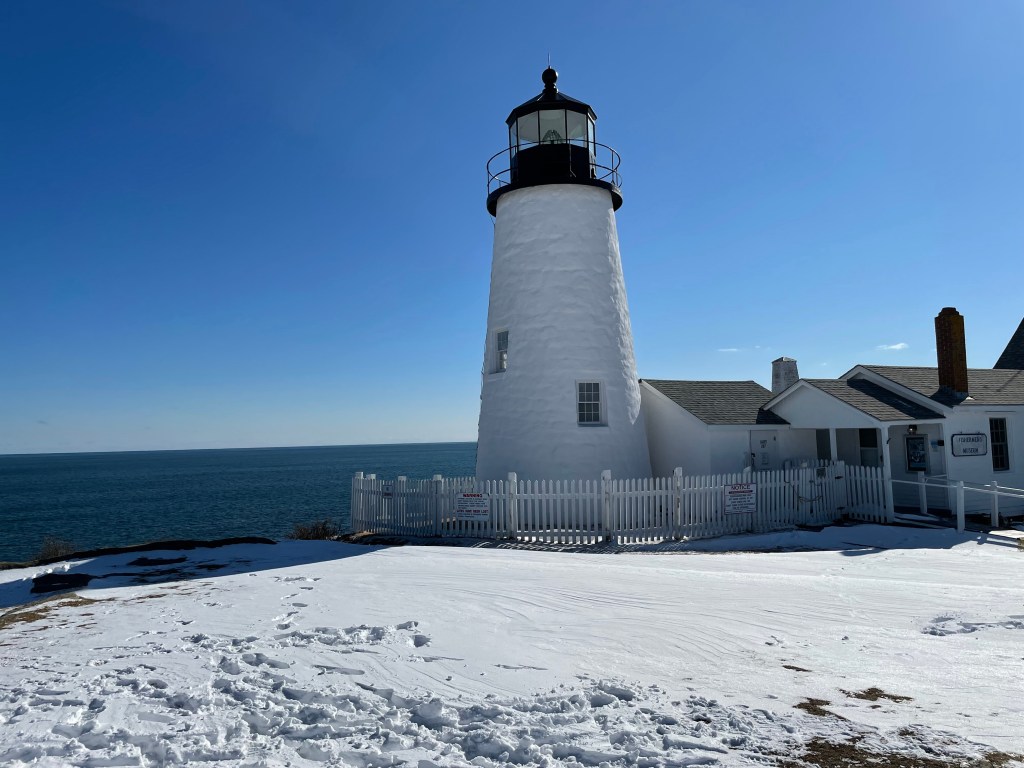
Pemaquid Lighthouse in Bristol is a haul unless you live on the peninsula, but it’s a great place to do nothing once you get there. (Raye S. Leonard photo)

My doctor tells me pandemic stress is real. It will take years even to begin to understand the ways in which our lives are being shaped by the mass effect event of COVID-19.

Pandemic stress is not all that ails me, I am sure, but I allow that I am not immune to it, even that it may be a large factor in my present overall state of being.

She asks if I am taking care of myself and I itemize the ways. Yet all the walking, yoga-ing, whole foods eating, meditating self-care doesn’t stop my (apparently fragile) system from stuttering, especially when the last thing I want to do is any of it.

I explain I’d rather walk only the distance of my car to a gas station door where I meditate on the perfect slice of pizza turning on a rack in its heated glass case, all of my intentions fixed on timing the yoga of removing the right bubble-crusted piece before it merry-go-rounds away, balancing it without losing any toppings on a pie server to my flimsy paper plate.

All so while I eat it in my car I can think of that self-caring salad I abandoned in the fridge at work.

“Well, you won’t eat gas station pizza forever,” she said.

What?

Wasn’t my doctor supposed to admonish me for gaining 30 pounds in the last two years, and go over healthier choices?

She elaborated only enough to say, “Don’t let your self-care stress you out.”

Can you get more downtime? Can you ever just do nothing?

I show up at the shell midden at least once a week to try.

Water slaps the hull of a boat navigating the mid-tide channel from Great Salt Bay to the sea. Dog tags clink on a collar. Small feet pound the path between apple trees, running ahead of mom chatter.

More people come to check out the seal, crowding the space between the swinging bench and the slope to the water. I am drawn out of myself and into conversations.

“There’s never enough time to do all the nothing you want,” according to Calvin & Hobbes creator Bill Watterson.

There’s always, always something.

Yet the dog inside me lies down, breathing mindlessly in its autonomic slumber. It may wake up again and throw itself against the chains of my mind, teeth bared and frantic. Probably. Probably it will.

But for now, I make my way back to the parking lot, one step, one breath at a time.

Ice House Park in Damariscotta Mills is open 8 a.m. to 8 p.m. May 1 to Sept. 30, but nobody seems to mind if you sit at the picnic table in the off-season. (Raye S. Leonard photo)

I’ve lived with general anxiety disorder for a long time now, incorporating all the self care I described (not doing) in my daily life to manage it. It is likely that abandoning these practices is the biggest contributor to my system meltdown. Yet I take my vitamin supplements every morning, drink herbal tea at night, show up in friendships, engage in meaningful work, and see a therapist. It is quite literally the least I can do.

One thing that has helped me is tuning in with all my senses when I am out there doing nothing – five things I see, four I can hear, three I smell, two I can touch, and one I can taste. (The last one is highly situational and often only when I take my gas station pizza to a picnic table).

I offer my personal story about pandemic stress with the hope that if someone is struggling, they might feel less alone. I am learning that an ability to self-reflect can be as helpful – maybe even more so – to others as taking on and trying to solve their problems for them.

I am no kind of medical or therapeutic professional.

If self care is failing you now, too, and you find yourself out of sorts, please make an appointment with your primary care doctor, who can hopefully reassure you that your physical body is intact and functioning well.

Panic attacks are terrifying and it helps also to have people you can call. Talking to someone – even about nothing – can be a good distraction. If you need more help, call the NAMI Maine helpline at 800-950-NAMI (6264). If you’d rather text, send your ZIP code to 898-211 to be connected to 211 Maine’s directory of services.

(“The Way Back” is a monthly column of reflections and revelations by editor Raye S. Leonard. Do you know a great place in Lincoln County to do nothing? Email her at rleonard@lcnme.com.)

This work was originally published in the April 28 print edition of The Lincoln County News.

Get lost

Waypoint added for Sheepscot General Store in Whitefield. (Raye S. Leonard photo)

There are many ways to get to know a place. My first three months in Lincoln County are highlighted by local advice, curiosity, a sense of adventure, and a low-key search for the best French fries.

I now know where to fill up my car for less, restock my vitamins, pick up tab dividers for my three-ring binder, grab a slice of pizza, and where to go for a private, mind-clearing moment.

I love the process of provisioning shop to shop and meeting people who gave up fancy titles in shiny cities to make and sell cheese, for example.

It’s tempting to settle into a well-worn path of comfortable weekly Lincoln County rounds now that I know where to find, for example, croissants that taste like those crafted at the best Montreal patisseries.

But a fire call in Whitefield at the beginning of the month reminded me that the best way to really get to know a place is simply to get lost.

That’s almost impossible these days with a GPS system built into everything. But a dead Fitbit battery and one bar of service on my iPhone Oct. 4 had me crisscrossing fields and farmlands relying on the compass in my nose to decide which way most expediently led back to Route 1, where I could confidently navigate my way home.

Fortunately, I drove by the Sheepscot General Store, where I visited once before, led there by popping the business name in Google Maps and streaming it to the console through Apple CarPlay.

As I sat in the farm’s driveway only a little bit lost now, I realized that the more I rely on GPS guidance, the less I pay attention to landmarks.

If I were on a boat without access to GPS, I would really be in trouble not knowing my waypoints.

Waypoints help you know where you are and where you are going. It’s easy to get turned around on the wide blue sea and as it turns out on the rural roads of Whitefield.

I bought a small bag of Bit-o-Honey penny candies and a loaf of wheat bread at the store, and after confirming that Wiscasset was roughly “thataway,” I headed out again.

This time I paid attention.

How did I drive by Sheepscot Links on my first trip to Whitefield and not notice a golf course? Waypoint added.

Fuzzy Udder Creamery and Chase Farm Bakery? I recognized those names from the Bath Farmers’ Market. Waypoints added.

And there was the Whitefield Elementary School. Always a handy waypoint. You’re never truly lost if you find yourself in a public school parking lot.

As I drove, I thought about how I got here at all, lost in Lincoln County.

One minute it seemed like I was in a Zoom call leading professional development for adult educators, picking up speed on the trajectory of my education career, and the next – as if time warped and teleported – I am chasing fire calls in far-flung places. Again.

The truth is I longed for it.

When you lose something you are pretty sure you will never get a second chance at, there are wistful moments of regret and longing, not thoughts exactly, but something that comes from the body, like a psychic tug in the right direction. Easy to intellectualize away for all the grown-up reasons. But still. A persistent semi- “if only … if only … if only.”

Despite my commitment to be the best adult education professional I could be, sometimes I’d look out the window of my office for a siren screaming in the distance, wondering what happened. Where and to whom?

Ah well. Not my job to tell those stories anymore, I would think, turning back to shuffle enrichment class proposals on my desk.

But I never lost my instinct to wonder … well … what happened next?

“There is always a road back. If we have the courage to look for it, and take it,” Chief Inspector Armand Gamage says in my beloved Louise Penny mysteries. “I’m sorry. I was wrong. I don’t know. I need help. These are the signposts. The cardinal directions.”

They led me to The Lincoln County News, a home port the likes of which I never thought I’d see again.

Waypoint added.

I hope you will join me for “The Way Back,” a monthly column of reflections and revelations as I crisscross back roads and byways. Look for it here on the way back page around the end of every month. If you know a good place to get lost in Lincoln County, please email me at rleonard@lcnme.com. Advice on French fries welcome, too.

This work was originally published in the Oct. 26, 2021 print edition of The Lincoln County News.

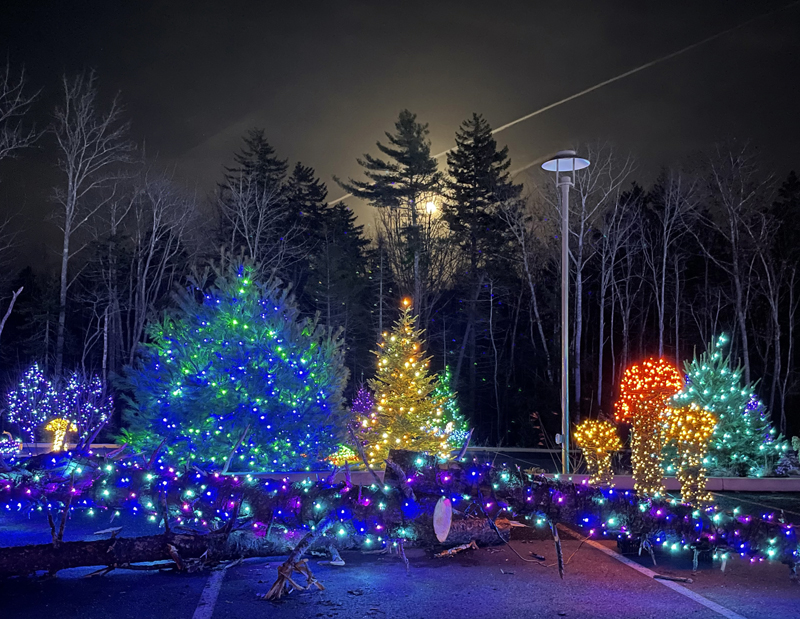
Lighting up in Lincoln County

A special luminaire tribute to Raye Leonard’s mom who died at age 55 of ovarian cancer on Dec. 27, 2005. (Raye S. Leonard photo)

It’s dark in the morning now when I leave Bath for Lincoln County. I follow a fast moving stream of headlights up Route 1. That’s how I know day is coming. If it was the middle of the night, I’d be chasing my own high beams, the road to myself.

It’s early enough that most days “The Dead at Dawn” radio show plays on WCLZ. I am accompanied by “Scarlet Begonias” or “A Box of Rain” as I clip along the waypoints of Wiscasset.

“Once in awhile you get shown the light … ” I sing, since I am alone, and if eyes be rolling, they’re in my own head.

My Grateful Dead days are well behind me. I was in college in the early ‘90s during the last years of the band’s epic tours. It seemed ridiculous to my 20-year-old self to follow a band around if you had no ticket or a place to sleep afterward. But I had friends who did, and while I never saw the band itself for all of the above reasons, I knew all the songs.

In the morning, just as sunlight pinkens the marsh grass of Great Salt Bay, I drive into my day at The Lincoln County News.

“Walk into splintered sunlight …” I hum, and pull into my parking spot by the staff door.

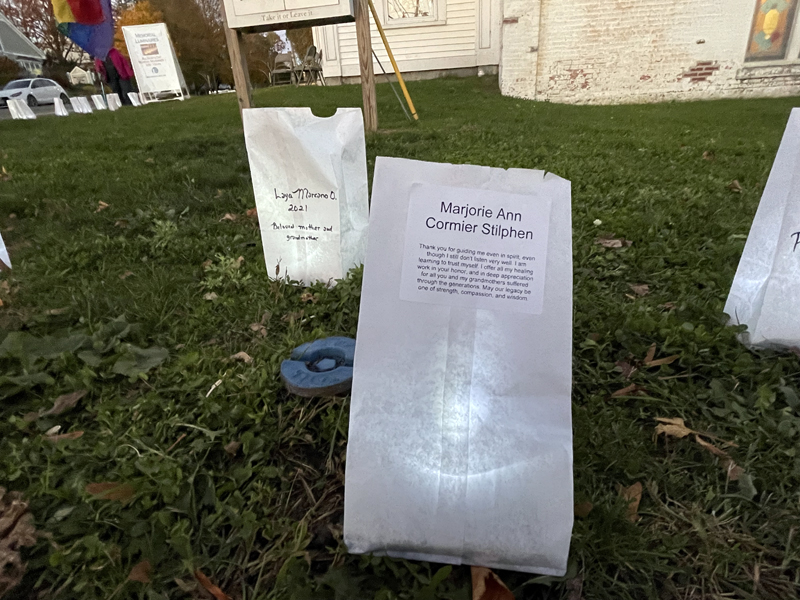
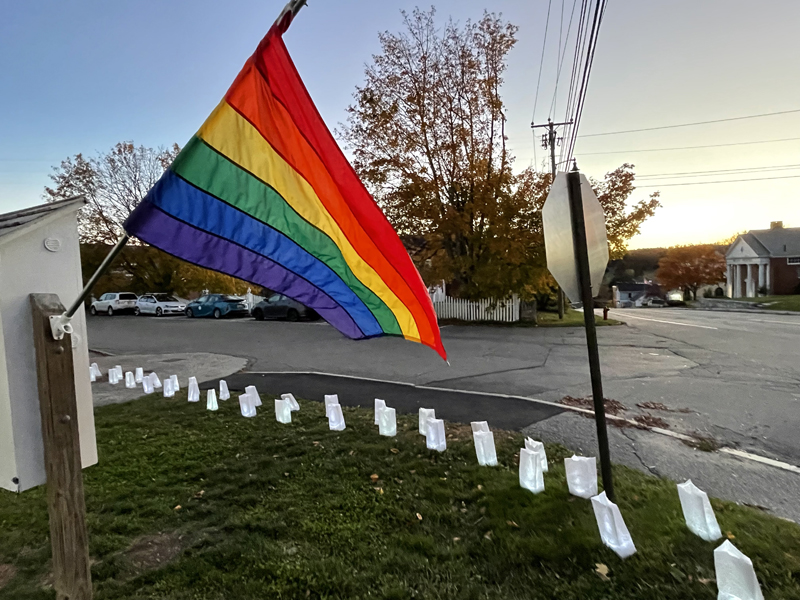
Memorial luminaires line the perimeter of Broad Bay Church in Waldoboro on Nov. 1, in observance of All Saints Day. (Raye S. Leonard photo)

There’s a lot about the news business that I like, and believe it or not, one of its humblest of its daily tasks is one of my favorites. There’s no glory in copy editing press releases, but both the necessity and the monotony of it is a newspaper variation on the Zen “chop wood, carry water.”

Copy editing is a great rest for a mind harried by the ever-shifting news cycle, and capricious community concerns.

I take great satisfaction in lifting the who, what, when, where, and why from wherever I find it buried in adjectives to the top of the story where it belongs, trimming up quotes and tucking in dangling modifiers along the way. I could do it all day. Sometimes I do.

That’s how I started what I call my Spark List. When I come across a press release for an event in Lincoln County that sparks not just my interest, but kindles something in my spirit, too, I add it to the list with the intention of going out and doing that thing.

I was drawn to the light in November, and it started with Broad Bay Church in Waldoboro’s Day of the Dead memorial luminaires on Nov. 1.

The church invited people to send in the name of a loved one who passed away to be put on a paper luminaire lit from inside with a battery-powered tea light. The white memorial bags lined the streets around the Main Street church, as the Rev. Nancy Duncan lightly tapped a hand drum and church members arranged and rearranged the sacks.

The almost full moon peeks through the trees at Coastal Maine Botanical Gardens Garden’s Aglow in Boothbay on Nov. 18. (Raye S. Leonard photo)

I’m terribly inconsistent about bringing flowers to the graves of my mother and grandparents. I usually show up tearful and empty handed to pour my heart out, pulling a few weeds that get tossed in the air.

So when I saw Broad Bay’s event, it felt like the perfect way to send my love to these people who shaped my life.

My mother and three grandparents all died in a short five-year period in the early 2000s when my kids were very small. If I didn’t do a very good job of caring for their final resting places over the last 20 years, I always tended to memories of them.

“I remember you,” I whispered, as the luminaires grew bright in the gloaming.

Perhaps ancestors were heavy on my mind this month because the next spark that captured my imagination was the 200th anniversary lighting of the Burnt Island Lighthouse on Nov. 9.

All my ancestors on my maternal grandmother’s side hail from the Boothbay region, arriving there in the 1760s (and in some cases, earlier).

My many times great Scottish grandfather Samuel Adams, newly arrived from Londonderry, N.H., late of Argyllshire, Scotland, married my many times great Irish grandmother Sarah Murray Reed (born at sea), on Dec. 30, 1766.

Fast forward 204 years and that date became my birthday. I’ve always felt a special connection to these ancestors because of the coincidence of occasions. I fancy that in some small way I am the culmination of their hopes and dreams for life in this place called America.

As I drove to the Spruce Point Inn where the Friends of the Burnt Island Lighthouse hosted a party for guests waiting to count down the 73,000th lighting, I did some math in my head.

A first-quarter moon rises over Spruce Point in Boothbay Harbor on Nov. 9 as guests wait for the 200th-anniversary lighting of Burnt Island Lighthouse. (Raye S. Leonard photo)

Were Samuel and Sarah Adams still alive in 1821 when the tower first cast its lifesaving beams across the harbor? Some or one of their sons and daughters? Grandchildren?

Chances are excellent that as Burnt Island Light blinked on for the very first time, one of my ancestors watched it.

And there I was 200 years later watching, too, except this time if you blinked you missed it. Lighthouse automation being what it is, the 200th birthday lighting was more of a red-glow in 6-second intervals in keeping with modern technology.

Other lights caught my attention, too, like the seminal Gardens Aglow press night on Nov. 18, at Coastal Maine Botanical Gardens in Boothbay, which I enjoyed at 5 mph sharing ancestry stories with a young person thinking about moving to Lincoln County.

I was fortunate to also attend the very first Gardens Aglow press night back in 2016, and whether on foot or by car, it’s an enchanting experience.

For the second month in a row, I missed the Edgecomb Community Church’s full moon candlelight labyrinth walk on Nov. 19. But if you can count on nothing else these days, the full moon will shine again next month.

And I’ll keep following all the lights of Lincoln County.

This work was originally published in the Nov. 26 print edition of The Lincoln County News.

(“The Way Back” is a monthly column of reflections and revelations as editor Raye S. Leonard crisscrosses back roads and byways. Is there some light in Lincoln County she should know about? Email her at rleonard@lcnme.com.)

No way back

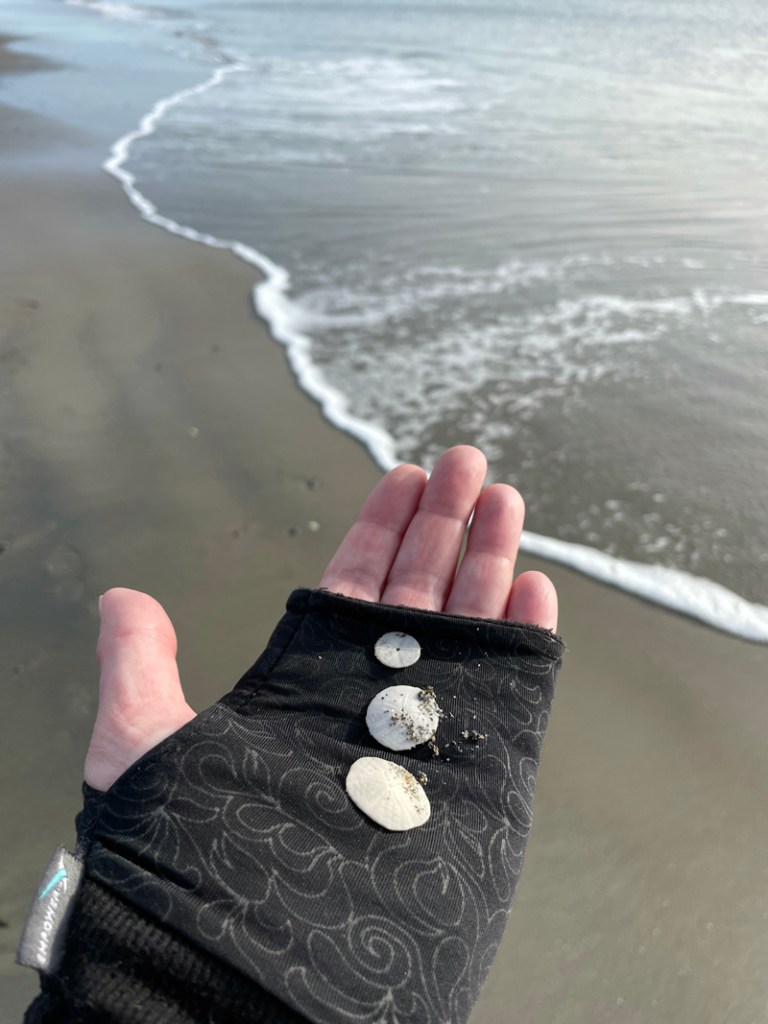
Sand dollars found on a walk at Popham Beach in December. (Raye S. Leonard photo)

I was on vacation between Christmas and the new year, and made time for a beach walk, one of my favorite winter things to do. I feel a bit traitorous writing about Popham in my Lincoln County News monthly column, but keep in mind, it was all Lincoln County once, and for a very long time, too.

You have to go way back before the major Midcoast artery of Route 1 and all its backroad veins to remember that once it was the peninsulas of Bristol, Boothbay, Georgetown, and Phippsburg that formed the hub of commerce, homesteading, and trade in our region.

Way, way back they were all part of York County, but the Midcoast quickly distinguished itself as an epicenter of colonial development, and in the early 1760s the province of Massachusetts Bay allowed Lincoln County to incorporate “all lands east of the New Meadows River, Merrymeeting Bay, the Androscoggin River, and extending north and east all the way to Canada,” according the Lincoln County Historical Society website.

That’s easily most of Maine, except for the bottom-most tip which even now many regard as not really Maine. It never shook its Massachusetts-ness.

Back when we were all Lincoln County, major transportation was done by boat. Those fingers of land that in a 21st-century January seem like such a long stretch from the convenient upriver hubs of Damariscotta and Bath, were just a “hop, skip, and a jump,” from each other. Or should that be a “hitch, sail, and jibe”?

The truth is they still are. It just seems to take a long time to get there in winter, by road.

It’s worth it.

I like the beach to myself, thank you very much. I prefer Popham, especially the fort-end, but Reid State Park on the Todd’s Point side will also do in a pinch. I’ll take Pemaquid Point Lighthouse, too. And any empty harbor save for the working boats that remain.

A drive down Route 32 in Bremen, Route 130 in Bristol, Route 127 in Georgetown, or Route 209 in Phippsburg in winter promises places without all the people that flock to these peninsular destinations in summer.

You want to know Midcoast Maine in your bones? Bundle up. Pull your Boggs over thick socks. And drive alone. Walk alone. In winter.

Let the silence of the season settle over you like the sheen of fine ice. In that brittle state is what I believe to be true: This is a crisp and beautiful place to call home, but in the crystalline face of winter, it’s also a bit inhospitable, inconvenient, and empty.

I walk at Popham in the bleakest of months at low tide because that’s when I find the most sand dollars. It’s good to have goals.

I walk at Popham year-round because it’s new to me. Believe it or not, we never went there when I was growing up. It was any old stretch of shore I noticed looking back as we rounded Seguin Island on my grandfather’s boat headed to Boothbay Harbor for the day. It was a road sign pointing to a turn we never took.

How could I live in a place for almost 50 years as if a major state park didn’t exist in my backyard? A place so big and vital people carry it in their hearts all over the world, and return to it as often as they can, led by memories and imagination.

I am told a story about how when I was around two, I almost drowned at Popham. My aunt saved me. My mother didn’t swim, so I don’t know how “almost drowned” I actually was. Maybe I just went under and stayed there too long. I was – and still am – confident in any body of water. And, to be completely honest, I played that trick on my mother many times growing up. It’s easy to imagine I started as a toddler.

I always did things that made my mother nervous. It got her attention like nothing else.

But what matters here is we never went back to Popham. Plenty of beaches in the Midcoast, and the beach was the center of our summer recreation. The trunk was packed in June with everything but lunch. The beach was Small Point, at the very end of the Phippsburg peninsula, where at Head Beach there was no “undertow,” which, my mother said, is what almost took me.

Once in a while, we went to Reid State Park in Georgetown, but only to the lagoon, because there was “undertow” on the other side.

Every summer we made an awkward pilgrimage to Pemaquid Beach with Nanny and Papa in their Buick, sliding back and forth on the bench seat in the back on our towels. I have this vague memory that my grandfather proposed to my grandmother, a “Boothbay girl,” at the lighthouse, or something. They were married in Newcastle in September 1949. But I have no way to verify that now.

My grandparents were not beach people, and brought with them high-backed folding captain’s chairs where they sat in their laced-up shoes and long pants watching my brother and me get “soaking, wringing wet” before we breaded ourselves in sand.

My mother ignored all of us, lost in a paperback with giant sunglasses on top of her prescription specs, smooth and tanned in her one-piece suit, as much a part of the landscape of the beach for my brother and me as seaweed and shells.

I see her there still.

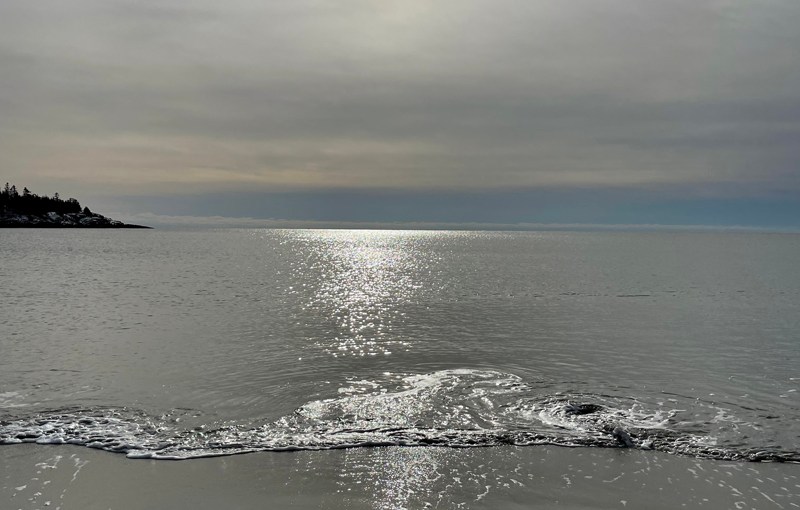
Filtered sunlight at Popham Beach on Dec. 27, 2021. (Raye S. Leonard photo)

I don’t know where other souls go when they leave their earthly bodies, but my mother’s went to the beach. I always find her there.

She’s in every sand dollar. And every sand dollar says I love you in ways she never could. I only find them at Popham, that place where she almost lost me, in her heart and mind anyway, and in the story handed to me, that beach she never risked going to again, and that never existed to me in any real way until I found it at age 48.

I had a walk on Coronado Beach in San Diego in November 2019 with one of my best childhood friends. I was attending an adult ed conference, and she drove down from Santa Barbara to meet me. We hadn’t seen each other since our high school graduation 30 years before.

When I got back to Maine, I said to my husband, “It would be so cool if there was a beach like that here, where I could just go and walk, that stretches on forever.”

He just stared at me.

I was in graduate school the Christmas my mother died. Her funeral was on my 35th birthday. A couple days later I checked into my residency at the Stone House at Wolfe’s Neck in Freeport. I have only one memory of that week of workshops and readings. I sat on an all-season Adirondack chair in the snow and looked east across Casco Bay.

Sometimes there is no way back.

But I’ll follow those well-marked coastal routes anyway.

This work was originally published in the Jan. 6, 2022 print edition of The Lincoln County News.

(“The Way Back” is a monthly column of reflections and revelations as editor Raye S. Leonard crisscrosses back roads and byways. Email her at rleonard@lcnme.com.)

Voices from the past

I love the way we talk. Mainers, I mean. When I hear people speaking with the types of voices I remember from when I was growing up, I sometimes get a little teary. I am so thankful, like the Maine way with words is a language all its own, and one I am afraid is dying out.

I’m just here to listen, I thought. I half closed my eyes. The voices of townspeople filled the room where the select board meeting was held. I welcomed hearing these half-remembered ways of saying things as much as the concerns they expressed. Vowels rose and fell where consonants might be. The cadence of vocal inflection was succinct yet trailing off in places where assumptions might be used instead. How did I know how to fill in those blanks?

The rhythm of words both spoken and unsaid carried me backwards in time.

That’s how people talked when I was growing up, people in my family, people everywhere it seemed. I’m talking about the “Maine accent,” but it was more than a collection of sounds.

Wrapped up in the way words were said was also a way of being, an orientation to the world. I don’t want to generalize too broadly, but there’s a certain amount of matter-of-fact resignation in Maine speech best summed up with “ahdunno,” which frequently comes at the end of any conversation. It’s a verbal shrug that could mean this or it could mean that, but nothing personal.

“Whatever,” as people say today.

I want to be clear that the Maine accent I am talking about is not the bumper sticker one popularized by comedians, even E.B. White.

In fact, all the “ayuhs,” “wicked pissahs,” and “can’t get theyah from heyahs” were a little offensive when I was young in the way that you laugh along because you want to be in on the joke, but afterward, you think, hey wait a minute, in my case, my mother talks like that, and if I follow the logic of the humor, is she a half-wit?

My mother was the business manager of a private boarding school. She worked with people who came from all over the country. Sometimes they told her, “You sound just like a Mainer.”

She would say to me later, “I just talk. Ahdunno.”

And because I was a know-it-all teenager at the time, I might point out that a word like “horse,” sounded like “huss” when she said it.

“Mum, say ‘car.’”

“Cah-er,” she would reply, like she was sounding out a word from a foreign language textbook.

“See?”

Once my mother came home from work and shared a story of how she stood in her well-appointed office, in a former mansion no less, with some parents from away who gave her words to say “like a Mainer.”

“That sounds humiliating,” I recall saying. I felt protective of my mother in that moment. It was one thing for me to tease her about how she talked, but quite another to think of people giving my mother words to say like she was some kind of roadside attraction, a vocal epitome of place.

“You know, I think it was,” she said, but shrugged it off.

I’ve spent my whole life trying to sound like anything else.

I am not sure I am alone. Maybe my whole – specifically Maine – generation was encouraged to do better, be better, at the very least sound better than our parents and grandparents.

I have one (in hindsight) confusing memory of an uncle saying to me in my late teens, “You gut ta go ta college. You know, ya dun wanna be like them othah ignorant people.”

Like who?

I’m a mid- to late-20th-century Maine woman. The double helix of my DNA spirals with 13 generations of hardscrabble Scotch-Irish, French Canadian grit. My ancestors carved farms out of ledges, dragged fish from unforgiving waters, and worked hand over fist in the shipyard, never venturing far from home.

“Tougher than a sack of hammers,” my Downeast husband would say, an axiom picked up working in his father’s boat shop on Mount Desert Island.

That’s us.

Yet the last thing my family wanted for me was to be the next generation of brute force labor, or paycheck-to-paycheck piecemeal. Maybe they couldn’t show me the way – never having been there themselves – but I understood that blank space left in our conversations could be filled with anything as long as it was nothing like them.

Is that me? I have a couple degrees and a bunch of certifications, a well-qualified white collar professional resume, a mortgage, a car payment, three kids.

Am I there yet?

Because all I want to do is go back. Yet I know quite literally you cannot get there from here.

The closest I’ve come is the select board meetings I covered in Lincoln County in January, where I had the privilege of covering a town’s news.

I followed along with agendas and took notes.

When I asked questions, I found myself speaking the way I did to my mother, in my family, like they spoke to each other, like we spoke to the world.

I spoke like a “Mainer,” even though I’m not crazy about referring to it that way, layered as it is with stereotypes and low-key shame you’d be hard pressed to find anyone willing to talk about.

As a born and raised Mainer, I’ve been doing this sort of code switching my whole life. Code switching is a linguistic phrase that describes what someone does when they combine two or more languages in a conversation.

Code switching can also be cultural, which I believe is closer to what I did, since we were all speaking the same language.

Cultural code switching happens when you change the way you speak, your accent or dialect, to match the group you’re with. It’s not a fake move to fit in or anything. You have to know the code, every nuance of it, to do it successfully.

I fell into that old speech pattern effortlessly like it was my native tongue. Because it is.

I don’t know how long I’ll be covering select board meetings, but as long as I do, even if just for a moment, I’ll close my eyes and let myself be carried back by these voices from the past.

This work originally appeared in the Feb. 3, 2022 print edition of The Lincoln County News.

(“The Way Back” is a monthly column of reflections and revelations as editor Raye S. Leonard crisscrosses back roads and byways. Email her at rleonard@lcnme.com.)