A Clueless Catholic Goes to Mass

I’m getting my Catholic on this holiday season.

I can’t really say I was raised Catholic because for those who truly were, my story falls far short. I also don’t want to trade on pop culture cliches of Catholicism to convey what being Catholic meant to me. I never wore a plaid school uniform because I did not go to Catholic school. I’ve surely sinned, and done plenty of penance. But I don’t recall many formal confessions.

I was baptized late – at age 4 – after my younger brother was born and I was well on my way to heathenism. I am not sure I set foot in St. Mary’s again until I was 7.

I was signed up for Confraternity of Christian Doctrine (CCD) classes so I could make my First Communion on time, likely at the behest of my French-Catholic grandfather, who I called Papa. He took me to Mass with him on Sunday so halfway through I could be dismissed with the Catholic children who had years of religious education on me. We sat in a circle in the basement community hall learning catechism from picture books.
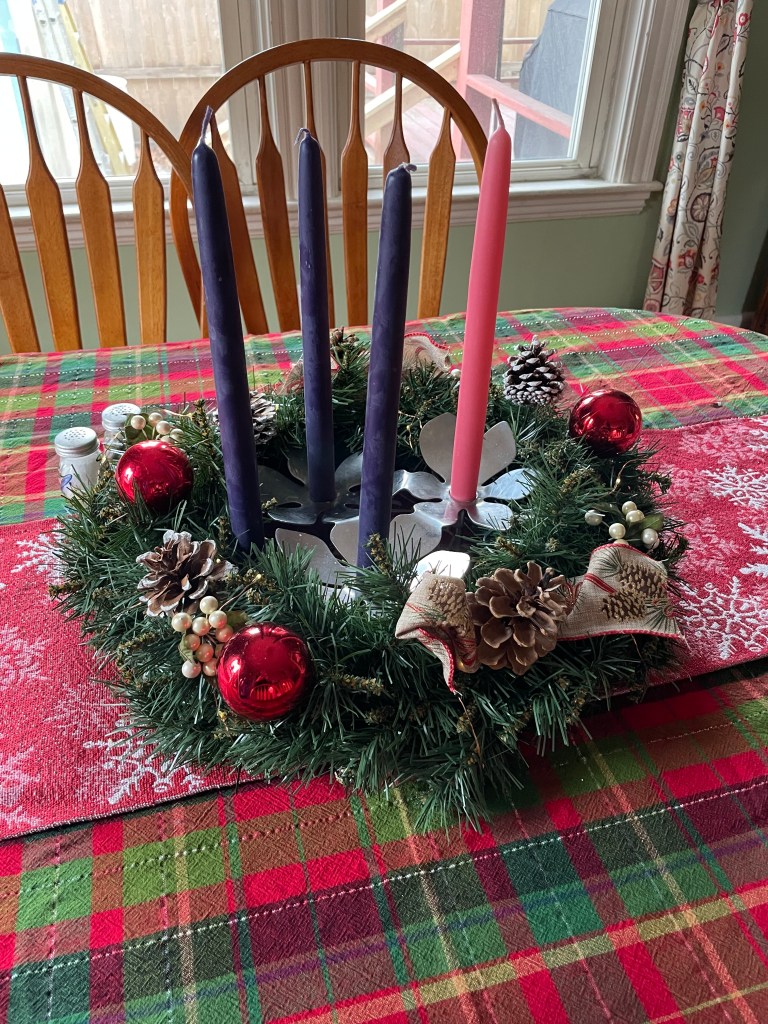
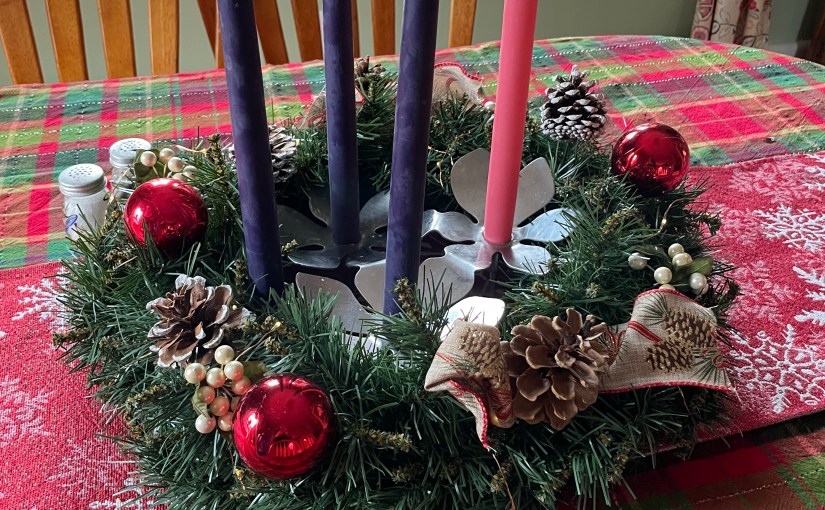
A bit makeshift since I could not find a proper metal Advent candle holder. This will have to do. The purple candles are for the first three Sundays of Advent. They represent hope, peace, and joy (in that order). The pink one is for the Sunday before Christmas and it stands for love.

I wrote about some of my Catholic memories many years ago in a column for the newspaper where I worked. The kind of Catholic who probably knew for sure when to kneel and when to stand during Mass came to the office to complain about the column to my editor.

I no longer remember exactly what I wrote, but I still feel ashamed of whatever ignorance caused me to write something that offended that Catholic. I revered Catholics like her who genuflected without hesitation, unlike me. I made the sign of the cross on a two-second delay to make sure that’s what I was supposed to be doing. My face still flushes at memories of making shapes with my mouth because I didn’t know the words to a prayer.

Additionally, an uncle called me to share his concerns when that column ran. He was not even from the Catholic side of my family. But he was the kind of older relative who insisted that because he knew me as a little kid and teenager, he knew me still, decades later – better even than I knew myself. My uncle shared that he had no memories of me going to church with my grandfather.

Interesting. My uncle’s wife – my aunt – was none other than my godmother! There she is in pictures of my baptism holding my younger brother over a gold basin while holy water poured over his head.

My uncle implied I made up my church memories.

It may not have been the Catholic story of my mother, who was raised with all the rites, plus extra restrictions only the French could divine from Scripture. But I didn’t imagine it. How could I forget learning to get dressed and sit still on a Sunday morning after spending 7 years watching cartoons in my pajamas instead?

So I am wary of writing about my Catholic experience at all. I never felt like I was doing it right. So I worry I won’t be able to write about it right. I’m about as clueless as a Catholic could be – or should be if she’s going to call herself Catholic at all.

But I want very much to experience Advent as the spiritual – and for me, Catholic – journey it’s meant to be. It’s not just a chocolate countdown to Christmas.

So I showed up as the admittedly bad Catholic I am at St. Mary’s Mass on Dec. 3, the first Sunday of Advent. I mouthed over prayers, kneeled and stood when everyone else did, and put some money in the collection basket while we sang a hymn.

Afterward, I wandered around the sanctuary admiring the stained glass windows that so mesmerized me as a child. I used to track the light that poured through them at 10 o’clock family Mass, the sun signaling it was about time for coffee and refreshments, a highlight of my early church experience.

On the sill of each window was a necklace of rosary beads formed in the shape of a heart. A card said they were compliments of the Knights of Columbus, but just to be sure, I asked a woman who was passing out fliers if they were to borrow and bring back, or if they were for keeps.

“For keeps,” she said, and told me about a book study group starting soon. She wrote her phone number on a flier and handed it to me.

I chose a strand of purple and green plastic rosary beads with the Virgin Mary on the cross. Somewhere, I know, I have the rosary Papa gave me. That was for keeps, too. I searched my mind for where it might be kept after all these years. I wanted to hold it again in my hands, follow along with the instructions for How to Pray the Rosary, also compliments of the Knights of Columbus.

But all I really had to do to experience Advent as something holy was open my heart. I call forth my own imperfect Catholic story, tucked like a folded note hidden in a hymnal. I didn’t choose it, and there are parts I wish could be changed, but it’s unquestionably mine.

I unfold it now and hold it in the light of Advent. The first candle is for hope.

And I sure hope I am doing this at least a little bit right.
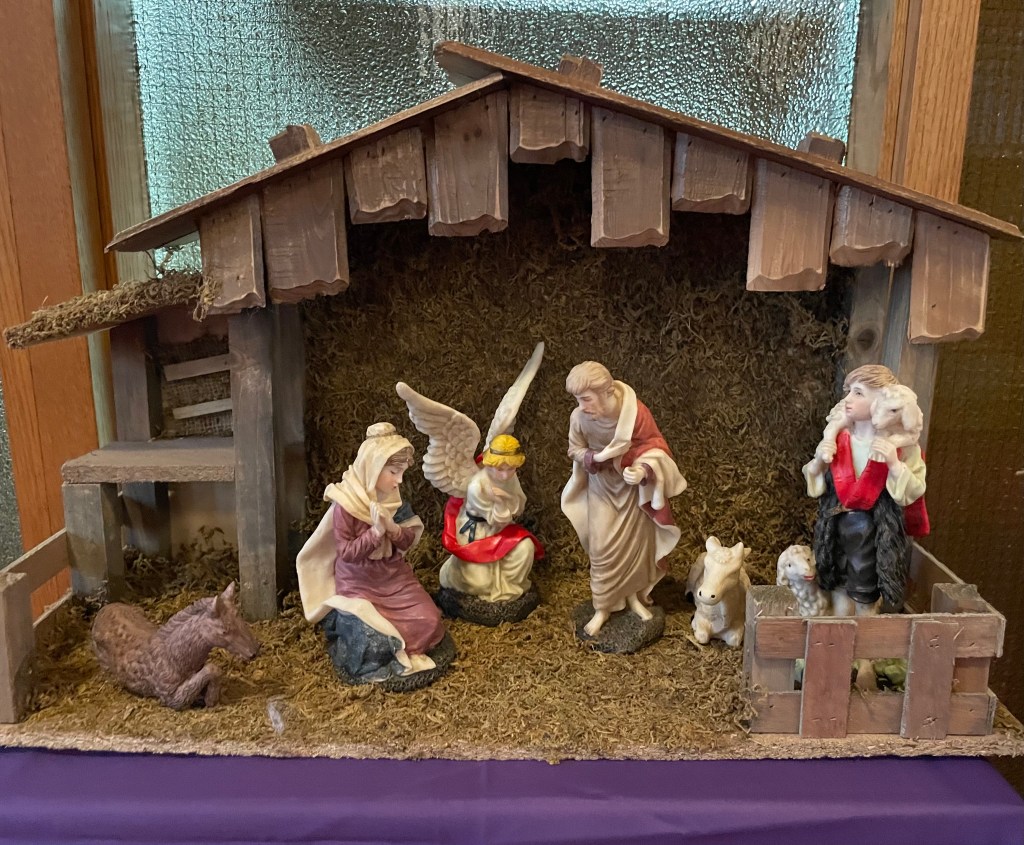
St. Mary’s Nativity, first Sunday of Advent..

Writer’s Notebook & Studio Invitations for May … and beyond

I invite you to establish a daily and weekly writing practice in your Writer’s Notebook. Find just 15 minutes for daily practice and just 90 minutes for weekly practice. 

We are living history during this COVID 19 pandemic. Many of us are working from home, homeschooling, and suddenly spending a lot more time in general on the homefront. I wish for you to capture your unique experience through your writing.

However, many of my students have shared that they have no writing inspiration at all. I know how they feel. I should be writing more, not less, right? I mean I have all this time on my hands. Except I really don’t. Not only do I feel busier than ever, I also cannot seem to settle.

One of my students wrote in an email, “I can’t let myself get too immersed in a project for fear the world will disappear when I’m not looking.”

Exactly.

How can we create the sense of safety we need to write? Here are some prompts that might keep you going. But if you find that you would rather read mystery novels, watch “Tiger King,” or listen to ’80s rock on full blast, please know that’s OK, too.

Daily, weekly, or any frequency that strikes your fancy 

Poetry: Keep a list of words and phrases you see in random places (bumper stickers, graffiti, signs, posters, art) that catch your eye. Use these words in your weekly writing time to make a poem.

Creative Nonfiction: Choose a verb and make its action something you complete every day. Then write about it. For example, I am working with the verb “mending.” Throughout the day, I am mindful of the things I do that could be regarded as some sort of mending. I write about that during my practice.

Fiction: Day 1. Set the pandemic scene using specific details. It can be your scene or one you imagine. Include a main character, and choose a point of view. Each day add a literary layer to it.

Day 2. What does your character want?

Day 3. Who or what is in the way? (Antagonist)

Day 4. Something your character didn’t see coming

Day 5. The only one who could help

Repeat

Here’s one of my favorite poems to keep you you going.

All genres: Each day, write down a scrap of conversation you overheard on a small piece of paper, fold it up  and put it in a can or jar. During your weekly practice, do one of two things (or make up your own): 1. Pull one scrap of paper from the container and develop it as an essay, memoir piece, or beginning of a short story or poem. 2. Dump out all the scraps and assemble them into a whole piece, fiction, creative nonfiction or a poem.

Permission Granted

by David Allen Sullivan

You do not have to choose the bruised peach

or misshapen pepper others pass over.

You don’t have to bury

your grandmother’s keys underneath

her camellia bush as the will states.

You don’t need to write a poem about

your grandfather coughing up his lung

into that plastic tube—the machine’s wheezing

almost masking the kvetching sisters

in their Brooklyn kitchen.

You can let the crows amaze your son

without your translation of their cries.

You can lie so long under this

summer shower your imprint

will be left when you rise.

You can be stupid and simple as a heifer.

Cook plum and apple turnovers in the nude.

Revel in the flight of birds without

dreaming of flight. Remember the taste of

raw dough in your mouth as you edged a pie.

Feel the skin on things vibrate. Attune

yourself. Close your eyes. Hum.

Each beat of the world’s pulse demands

only that you feel it. No thoughts.

Just the single syllable: Yes …

See the homeless woman following

the tunings of a dead composer?

She closes her eyes and sways

with the subways. Follow her down,

inside, where the singing resides.

Some resources for inspiration

These are some resources that support my writing practice and I share them with you in the hope that you might find inspiration here, too. Do you have a got to website or blog that nurtures your writing? Please share it in the comments.

The Writer’s Almanac for poetry delivered daily to your inbox

Ami Kunimura’s blog at The Self-Care Institute for weekly prompts to help you stay centered on your own path and compassionate toward yourself.

Maine Writers & Publishers Alliance is a good resource for events, workshops, and publishing news. Fair warning: The organization’s retreats are pricey in my opinion, but there are plenty of other opportunities to gather in community with other writers.

If you are interested in independent publishing, check out Maine Authors Publishing, for the most comprehensive information on self-publishing in Maine. My graduate thesis was a deep dive into the history of independent publishing in the U.S., and I urge writers to consider it a viable option for producing their work.

Sagadahoc Writers’ Sangha offers weekly writing workshops in Phippsburg – and due to COVID 19 – ONLINE. This is a good source for weekly prompts and companionship. The hosts also offer retreats at their historic property.

I enjoyed a free Writers Camp with Renee Long recently. She offers some great tips for developing a writing HABIT. This is much more time management and creative mindfulness than it is about the craft of creative writing. Still, for anyone who feels like they do not have time to write, it can pry loose some inspiration.

When I get stuck and find myself circling and circling and circling an idea that I can’t seem to get underneath to meaning, I engage in a practice called Proprioceptive Writing, which was developed by a couple in Maine in the 1970s. I can’t recommend this practice enough for those times when your head and heart feel thick with stuff to sort out.

And finally, my writer’s notebook evolved from the practice of Bullet Journaling. My version is much more creative and artsy than the original practice, but it all began with my return to analog timekeeping. For inspiration, I heavily consult with Pinterest and Instagram. It’s amazing what some people do with their bullet journals!

The last best thing I wrote

What was the last best thing you wrote?

Here is an excerpt from the prologue of a book I began writing in spring 2019 called The Other Side of the Moon. It may not be the last best thing I wrote, but it is the last most complete thing.

Please share your last best thing in the comments!

“Crimson Tide,” “The Red Wedding,” “Carrie,” “Shark Week.” Young women have fun ways of referring to what my mother, with no pop cultural references whatsoever simply called being “on the rag.” The first time one of my female college first years emailed me to explain she had “checked in at the Red Roof Inn” and wouldn’t be in class, I sent back a note that said choosing to leave early for vacation was not an absence I could excuse.

A week later, possibly because she trusted me as a woman – we all bleed, after all – but more likely because she wanted to point out all the feminist stuff I talked about was actually a load of personal bullshit when you got right down to it, my female student hugged her neatly organized English composition binder and “The Writer’s Reference” to her chest and explained what she meant was she got her period. It was heavy, and she got “really bad” cramps. Did she need a doctor’s note to have it excused?

That was 12 years ago. I was 37. My kids – all boys – were 9, 6, and 3. I’d spent a decade giving birth to them, and burying the women I called Mum, Nana, and Spike. I was too tired, too busy, and too caught up in cobbling together a version of motherhood based on a faulty sense of what was “normal,” and certain television role models, like Caroline Ingalls of Little House on the Prairie and Caroline Brady of The Brady Bunch to keep up with evolving feminine slang. 

I became pop culture illiterate when I became a mother in 1999. The last television show I watched with fervent regularity – The X Files – aired in the late ‘90s. I might see a movie in a cinema once a year, on my birthday. Once it was Cold Mountain with Nana and Mum. Another it was a French film called Amelie

There was no Urban Dictionary. No Netflix, Spotify or iTunes, no Facebook, no apps of any kind. Nothing was on demand. My music library was kept in a box of mixed cassette tapes given to me to listen to on my car stereo by boys who told me love stories in songs by Alice in Chains and Mother Love Bone, or Pink Floyd and the Grateful Dead, or deep back catalog Bob Dylan and even more obscure Tom Waits. 

They were very different boys.

I am 48.5 now. My children are on the launch pad of the rest of their lives. I know that Aunt Flo doesn’t come from Aroostook County, a Quebecois widow born Florence who drives south of Bangor once a month to have her toenails trimmed by a podiatrist her sister recommends, to marvel at the forsythia already waving in the sun, and to eat lunch at Cole Farms. She loves the homemade rolls.

But I’m pretty sure Rosie O’Monthly, my own personifying name for my period might be a Scotch-Irish fisherman’s wife, reminding me of New England boiled dinners with cabbage, potatoes, carrots and ham, and Pabst Blue Ribbon with a whiskey back.

Rosie wears big sunglasses that hold back a velvet sheet of black hair. She likes paisley print cropped corduroys and strapless halter tops she wears braless so her nipples dot the bib like perfectly spaced buttons. She shows up in sandals with a backstrap so her rough heels don’t slide out. Rosie drinks Diet Pepsi in a paper cup. Everything is paper so she can throw it away when she’s done instead of washing, drying it and putting it on a shelf. Rosie takes a broom to them when the grown men who used to be her little boys start wrestling in the kitchen, whacking the corn bristles on their backs and heads until they knock it the hell off. And Rosie is baked macaroni and cheese with buttered toast cubes on top, barely visible under a layer of black pepper and salt, and canned peas on the side sliding around in oleo.

Rosie is my sure thing, coming to me every month since 1982 when I was 11. She arrives like a Buick rumbling onto the gravel of a driveway, rolling down a window, slowly pulling the sunglasses above her bangs. I greet her with relief, pour a cup of tea, and build a fortress of pillows and blankets around us. She’s a wacko, but despite her colorful character, I know I can count on her like no one else. She’s the solution to all my recent problems. The sun coming out on a cloudy day.